










Just five years after PASPA was repealed, the online sports betting and iGaming landscape is constantly evolving in the United States. With a flood of new sportsbooks and exponential growth in the market, where many states are legalizing online gambling, without a doubt, a real revolution is underway. But what does the future hold for gaming in that country? What are the upcoming trends you should watch out for? Let’s discover them in this article!
Exponential market progress
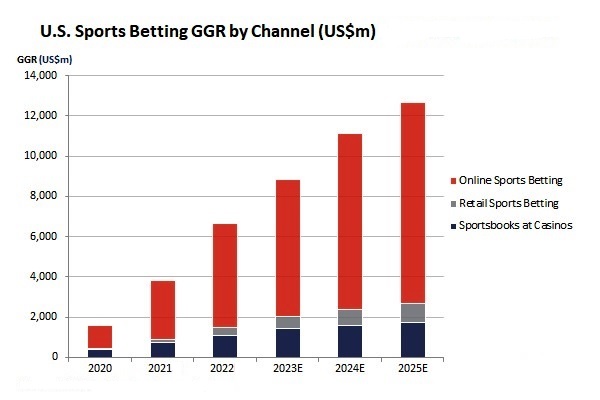
The online sports betting market in the United States has experienced explosive growth in recent years, and all indications are that this trend is set to continue. The strong advance is largely due to legislative changes that have allowed states to regulate the activity.
The Miscasasdeapuestas.com/us team, a popular online bookmaker comparator in Spanish, analyzes the expansion of sports betting in the U.S. market and raises its regulatory challenges.
According to various indicators from the American Gaming Association (AGA), in the U.S., on the last year, the GGR of online sports betting was approximately USD 2.24 billion (out of a total of USD 7.5 billion in sports betting, including in-person modality). This development has been driven by the rise of sports betting apps, as well as the COVID-19 pandemic, which played a crucial role in that evolution. With the restrictions on physical sports, many bettors turned to online platforms.
In regional terms, some interesting points that can be mentioned are the following:
1) The states of Nevada, New Jersey, New York, Illinois and Pennsylvania lead the online gambling industry regarding revenue and active users.
2) States like Michigan, West Virginia and Colorado have also seen significant growth in their online sports betting markets since legalizing that segment.
Projections suggest that this advance will continue in the coming years. According to a report by Statista, revenue in the U.S. sports betting market is expected to reach USD 7.62 billion in 2023 and even profits will expand to USD 23.8 billion by 2026.
That puts the United States as the country with the second highest income from online sports betting worldwide, behind Australia.
Nevada: A Pioneer in Sports Betting
Nevada, home to the gambling mecca Las Vegas, was the first state to legalize and regulate online sports betting. With a thriving market, Nevada is a role model for many states in terms of how to handle iGaming and online sports betting. Until now, it was the state that led the betting market, although this last year it has been surpassed for the first time by New Jersey.
New Jersey and New York: Leaders in iGaming
Since New Jersey and New York legalized sports betting in 2018 and 2022, respectively, there has been explosive progress in the iGaming industry in those states. With a wide range of online sports betting and casino operators available to customers, both states have established themselves as the undisputed leaders in iGaming in the United States, achieving maximum profits.
Pennsylvania: The Rising Giant
Pennsylvania legalized gambling sports and iGaming in 2019 and has seen steady progress ever since. With a significant population and a growing online player base, Pennsylvania is quickly emerging as a giant in the iGaming market.
U.S. territories that recently legalized online gambling
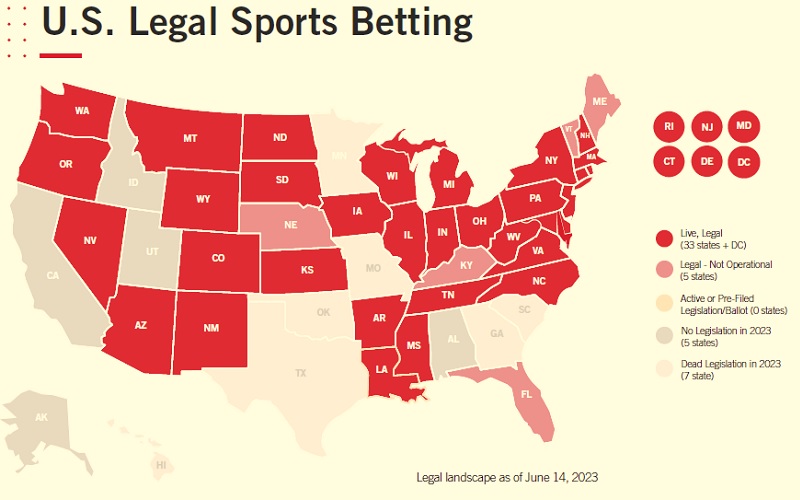
Massachusetts, Ohio, Kansas and Maryland have become the latest states to legalize iGaming since 2022 and early 2023. In addition, Maine and Kentucky are two of the states that have already approved sports betting, although their official activation is expected. Also, local online bookmakers are waiting the process to start applying for licenses.
For their part, North Carolina, Vermont, Florida and Kentucky have legalized sports betting as well, and other states, such as Texas, are close to making legislative progress to legalize online sports betting this year or next. However, that will most likely not be implemented until 2025.

U.S. iGaming Player Profile
According to various estimates for 2022, 6% of adults in the United States placed bets online, and 15% gambled with friends, either online or at a land-based sportsbook.
The expansion of sports betting in new states contributes to this growth, as does the diversification of the profile of players, who are increasingly younger and more versatile. This includes both men and women (approximately, 30% are women), as well as Anglo-Saxons and people of Latin American and Spanish-speaking origin, the latter community being increasingly numerous. In fact, according to data from the Miscasasdeapuestas.com/us team, more than 100,000 bettors in the United States are Spanish-speaking.

Bookmakers that dominate the U.S. market
Main sports betting operators in the country (those with more revenue and users, with an increasing presence in the different states and bigger popularity among players) are FanDuel, DraftKings, BetMGM and Caesars. These four online bookmakers took almost 90% of the market in the U.S. in 2022, according to a report by the consulting firm Eilers & Krejcik.
About percentages, FanDuel leads with 46%, followed by DraftKings (25%), BetMGM (12%) and Caesars (6.7%). This means that, although there are more than 30 online bookmakers in the country, the market is not very polarized, but rather is focused on these four big brands, present in almost all states and deeply rooted in the country’s betting culture, associated with sports teams, leagues or even land-based casinos and racetracks.

Advertising in iGaming in the United States: New trends and restrictions
It is clear that the trend towards stronger regulations in the iGaming industry is gaining momentum in the United States. States have been taking note of Ontario’s (Canada) moves, and it seems likely that we will see a tougher regulatory landscape in the near future.
Thus, operators of online casinos and gambling sites will have to be very conscious and careful when designing and promoting their bonus offers. Attempts to not comply with the regulations in this regard can result in significant fines and damage to the reputation of these sites.
That is why more and more states are implementing regulations and restrictions regarding the offers and the way they are advertised. For example, the terms and conditions are required to be clearly visible in all cases, and the use of the concept “free bets” has been prohibited.
In short, little by little, as the market matures, the United States is beginning to consider a more uniform system of control of the industry in a federal way, since, currently, the laws and regulations are in the hands of each individual state, without legislation covering the entire market.