









By Ulises Gil, journalist at G&M News.
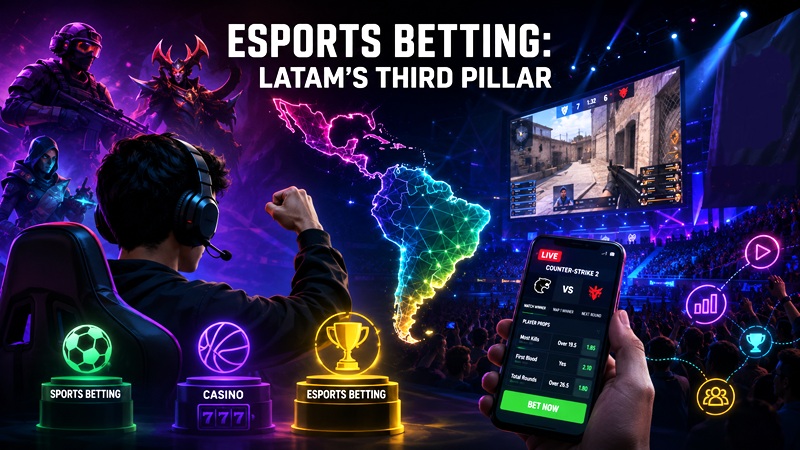
For years, Latin American Esports betting lived in the margins of operator strategy decks: a vertical worth mentioning in pitch decks but rarely worth a dedicated trading desk. That conversation is over. Football accounts for around 80% of bets in Brazil’s nascent legal wagering market and basketball ranks second, but Esports has overtaken tennis, golf, and combat sports to claim the third position. For an industry built on the assumption that football would absorb every available marketing dollar in the region, that ranking should rearrange a few quarterly plans.
The numbers underneath the headline reinforce the shift. Around 38% of regular Esports viewers in Brazil bet on Esports competitions (more than three times the equivalent figure in the United States), and over 40% of the country’s population is under the age of 30, while the average global Esports bettor is 23. That demographic alignment is what makes Esports something more strategic than a content add-on: it is a customer-acquisition lane into a generation that operators have struggled to reach through traditional sportsbook marketing.
Regulation finally catches up with player behavior
Globally, Esports betting remains a fraction of the broader sports wagering economy. Cognitive Market Research valued the global Esports betting market at USD 2.6 billion in 2024, with Latin America holding just over 5% of that revenue, or around USD 130.7 million, and a projected CAGR of 7.4% through 2031. Brazil dominates within the region: the country’s Esports betting market was estimated at USD 55.9 million in 2024, with a projected CAGR of 8%, while Chile sits near USD 9.4 million and the rest of LatAm combined adds another USD 21 million.
Those figures look modest next to football, but the trajectory is what matters for operators planning a three-to-five-year horizon. Industry projections place LatAm Esports betting on track to generate over USD 200 million in 2026, with the broader regional iGaming market expected to reach USD 10–12 billion by 2028. The compounding effect of a young, mobile-first audience aging into higher disposable income is exactly what specialist providers have been building toward.
A regional market still small in absolute terms, but compounding fast
Brazil’s regulatory turn has been the single largest structural change. Ordinance No. 36, issued on April 17, 2025, expanded the list of sports eligible for fixed-odds betting and explicitly legalized Esports wagering, while prohibiting exclusivity deals between operators and game studios. The SPA license now formally permits fixed-odds betting on Esports alongside slots, roulette, blackjack, crash games, and fantasy sports, removing the gray-zone ambiguity that had kept some operators from investing heavily in the vertical.
Paraguay has moved in a parallel direction with the abolition of the monopoly framework, and Colombia continues to refine its long-standing licensing regime. Latin America is implementing iGaming-friendly measures in countries such as Brazil, Paraguay, and Peru to make compliance more transparent, and the regulatory breakthroughs are running alongside growing interest in Esports as a betting vertical.
The trade-off is cost. With Brazil’s effective tax rate nearing 50% for licensed operators and additional GGR tax rises scheduled through 2028, marketing is one of the first line items operators are reviewing, which makes the question of where to spend, and on which vertical, more strategic than ever.
The sponsorship reshuffle: football retreats, Esports advances
The shift is visible in the sponsorship economy. Six clubs began Brazil’s 2026 top-flight season without a betting sponsor on their kits, a continuation of the 2025 trend in which second-division clubs struggled to attract betting brands. Football sponsorships have not collapsed, but the inflated valuations of the gray-market era are correcting.
Esports is absorbing some of that displaced spend. The Brazilian streaming ecosystem is what makes the LatAm Esports opportunity different from other emerging regions. Brazil has been the second-largest global market for Twitch with almost 17 million users, and many of the world’s leading streamers -including Gaules, Baiano, and Alanzoka- are Brazilian. That means the funnel from content consumption to betting intent is shorter and more cultural than in markets where Esports is broadcast through traditional sports networks.
Operators are responding by treating content as a product. Tom Santos, CCO at Bet Da Sorte, described the company’s positioning this way: “Today, we’re not just a casino brand or a sportsbook brand. We’re a content company, doing things on Instagram that big TV companies are doing”. That framing -sportsbook as media company- is the natural endpoint of an audience that discovers betting through the same channels where it discovers gameplay.
The live-betting and micro-market frontier
Where the next round of differentiation is happening is inside the product itself. Globally, the number of Esports bettors is climbing toward an estimated 80.2 million in 2025 and trending toward 95.2 million by 2029, with average revenue per user reaching around USD 34.90. Live betting and granular markets -round winners, first-blood, map-by-map handicaps, player props- are where the engagement gap is widening between operators that built their Esports stack natively and those that bolted it on.
Industry data shows that roughly 53% of operators are integrating gaming and betting platforms more tightly, 60% of Esports betting volume is now mobile, and 27% of users participate in fantasy Esports formats. For LatAm operators, where mobile already accounts for the overwhelming majority of activity, the implication is clear: the player props and BetBuilder features that anchor live-betting strategies in Europe are the same features that will define competitive positioning in the region over the next two years.
What this means for the operator deck
For executives sitting on capital-allocation decisions in the next twelve months, three things follow from the data.
First, Esports is no longer a vertical to be tested through a third-party feed and left alone. The handle is real, the demographic is the most valuable in the market, and operators iterating on second-generation tools (player-prop pricing, live trading models tuned to Esports volatility, integrated streaming) are pulling away from those still treating it as inventory.
Second, the marketing math has changed. With football sponsorship valuations correcting and tax burdens rising, Esports activations (team partnerships, streamer integrations, tournament broadcasting rights) are delivering more measurable customer acquisition per dollar in the Gen Z and younger millennial segments.
Third, the regulatory window in Brazil, and the gradual openings in Paraguay, Colombia, and Peru, are not permanent. Brazil’s SPA has moved from guidance to strict enforcement in 2026, the transition period has ended, and operators are facing the first wave of fines for non-compliance. The cost of entry is going up, which means operators who build Esports infrastructure now (compliance-ready, locally tuned, content-led) will be the ones with the runway to capture the next decade of regional growth.
The region’s Esports betting market is still a fraction of the global total, but for the operators who saw the football chance in 2018 and the regulated-market opportunity in 2023, the pattern by now should be familiar. The next pillar is already standing.