









By Damian Martinez, journalist at G&M News.
The idea of the Metaverse -a network of digital spaces, where social interactions can take place, facilitated by virtual and augmented reality- has gained traction as technology has improved. However, the social aspect of the Metaverse is not the only element to focus on since there are other exciting opportunities to be aware of.
CONCEPT AND DEFINITION
First, it is important to define precisely what is meant by the term “Metaverse.” Essentially, this refers to a network of digital spaces, where social interactions can take place. In many cases, consumers explore the Metaverse with the use of an avatar, and the Metaverse then serves as an interactive, virtual world.
Alternatively, the Metaverse can also be seen as the connection between virtual and real universes, where, in the future, technology can enhance the lives of users seamlessly. Virtual reality and augmented reality are the most commonly associated technologies with the Metaverse, although video games, Blockchain technology, and other solutions can also play a role.
THE METAVERSE FOR BUSINESS
Aside from the pure social features of the Metaverse, it is crucial to understand that the Metaverse has a lot of potential for businesses, helping them to bridge the geographical space between them and their customers, while creating memorable experiences, removing friction, and providing opportunities for interactions to take place.
For the entertainment industry, the Metaverse technology has already started to be seen in the example of virtual concerts and other performances. Some companies have provided these virtual concerts in the form of virtual reality experiences, while others have experimented with the idea of virtual concerts in video games like Fortnite.
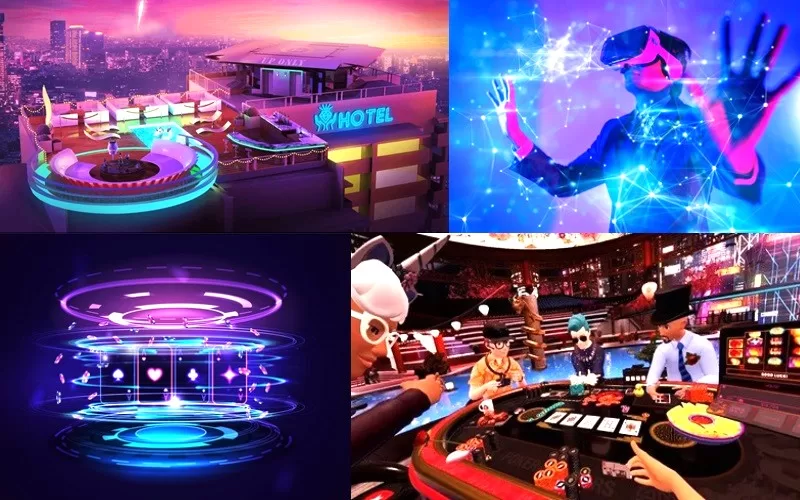
Increasingly, the Metaverse is being viewed as a viable concept for those in the casino and hotel industries to explore, and some properties have started to provide virtual spaces for digital meetings or celebrations to take place. Meanwhile, with e-commerce, the Metaverse can provide opportunities for customers to experience products or services before buying.
HOSPITALITY AND CASINO SECTORS
Traditionally, the hospitality industry has been associated with the physical reception of guests, but this concept has changed with the emergence of new technology and the birth of the Hospitality Metaverse. One of the biggest ways in which the hospitality industry is already starting to present itself within the Metaverse is through the development of Metaverse hotels.
For instance, hotels can offer virtual reality tours, or options to explore their hotel with an avatar during the booking process. This allows guests to get a clear sense of what to expect before they commit to booking a hotel room. However, it is not the only way hotels are digging into the Metaverse proposal. Some are providing their guests with access to virtual spaces, allowing them to host virtual birthday celebrations, or hold virtual business meetings.
Nightclubs are another part of the industry where Metaverse hospitality options are starting to emerge. Virtual recreations of nightclubs can allow people to experience many of the benefits of visiting a nightclub, including music, dancing, and interacting socially, without having to leave their homes. Virtual nightclub providers can then monetize the experience, offering options for users to improve their avatars and access new music. Casinos can also operate in a similar space, allowing customers to play games like poker, roulette and blackjack in a virtual casino, where they can interact with people, and explore a realistic recreation of the real experience.
MAIN DIFFERENCES BETWEEN THE METAVERSE AND VR
Virtual reality technology has become more widespread in recent times and VR hardware and software are among the solutions most widely associated with the concept of the Metaverse. Nonetheless, this has also led to some confusion, with many people finding it difficult to understand precisely how the Metaverse and VR differ.
Essentially, the defining aspect of the Metaverse is the creation of a virtual or digital space, where interactions can occur. This means that while virtual reality is a useful technology here, it is not a necessary one. The Metaverse could, indeed, take the form of an interactive game, where users control an avatar and interact that way.
Also, the concept many people have of the Hospitality Metaverse is inextricably linked to Blockchain technology, but it is important to understand that Blockchain can play an important role beyond this too. For instance, Blockchain tech can be used for ID verification, to process secure payments, or to track loyalty programs.
HARDWARE SALES AND PROSPECTS
Despite the excitement over the rise of the Metaverse, VR headset sales suffered a 24% decline in 2023 according to a report developed by Omdia, plummeting to 7.7 million units from 10.1 million in 2022. Further falls of 13% are expected in both 2024 and 2025, marking a challenging period for the VR industry before a projected resurgence from 2026 on.
The global active installed base remained steady at 23.6 million VR headsets in 2023, and only marginal growth is expected by 2028, signifying a plateauing market. According to Omdia’s latest Consumer VR Headset and Content Revenue Forecast, spend on VR content dropped 9.63% in 2023 to USD 844 million from the previous year’s USD 934 million. A gradual recovery is expected starting in 2024, leading to content revenues growing to USD 2.3 billion by 2028.
About prospects, George Jijiashvili, Senior Principal Analyst at Omdia, indicated: “The influx of new gaming hardware choices in 2024 will likely relegate headsets to a lower priority for gamers, who make up VR’s core user base. Amidst tech giants refocusing on AI, the lack of substantial investments in VR (apart from Meta) is set to result in a slump for the industry over the next two years.”