









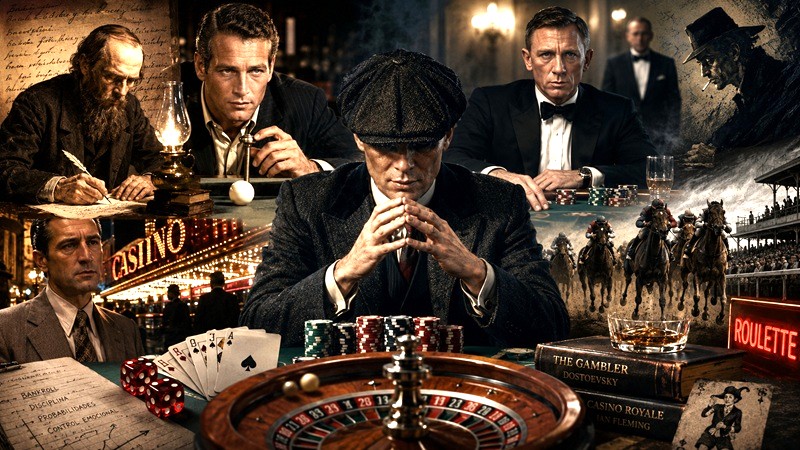
“There is no sight more beautiful than the face of a man who knows his soul is at stake.”
There is an image that persists in the collective imagination, seared into the cultural memory of the West: a green felt table, a champagne glass held with indifference, a gaze that doesn’t blink as the ivory ball spins, spins, spins… and finally lands on a number that could mean fortune or ruin.
The casino, in film and literature, has never been a mere setting. It is a character in itself, complex, contradictory, promising paradise with one hand while holding a one-way ticket to hell with the other. Will versus chance. Reason versus instinct. Control versus surrender.
DOSTOEVSKY: PLAY AS CONFESSION AND PUNISHMENT
We cannot begin this journey without paying homage to the absolute master, the one who not only wrote about gambling but lived it to its very core. Fyodor Dostoevsky was, quite openly, a compulsive gambler. From that open wound was born The Gambler, published in 1866, written in twenty-six days to pay off a debt to his publisher.
The Gambler is not simply a fictionalized confession. It is the foundational archetype of the modern literary gambler. Its protagonist, Alexei Ivanovich, doesn’t gamble for money. He gambles for the thrill, the vertigo of being suspended over the abyss. He gambles because in roulette he finds a purity that real life denies him:
“The amazing thing is that, in an instant, a single instant, a man can be completely transformed. He can go from the blackest despair to the most dazzling joy. Roulette is the only place where that happens honestly. Without excuses. Without lies.”
Dostoevsky understood something that a hundred years of psychology would confirm: the gambler doesn’t seek to win. He seeks the moment before knowing whether he has won. That space of infinite possibility, where fortune has not yet passed judgment, where everything is still possible. That instant, for Dostoevsky, is the only true paradise within reach of modern man.
The Gambler remains the best warning about the chasm that separates disciplined bankroll management from emotional surrender to chance. Dostoevsky doesn’t preach. He simply shows. What he shows is more terrifying than any prevention campaign.
CINEMA OF THE 60s AND 70s: WHEN THE CASINO WAS A STATE OF MOOD
Paul Newman, in his gray suit and wide-brimmed hat, plays Eddie Felson in The Hustler (1961), a pool player whose transposition to the poker table is immediate. He has the talent to beat anyone… except himself. The film captures something essential about the psychology of the gambler: you don’t lose because of bad luck; you lose because of pride.
An immortal exchange:
“Eddie, why do you gamble?” “Because I don’t know how to do anything else.” “That’s not true.” “It is when I’m at the table.”
The Hustler reminds us that for some, gambling ceases to be a choice and becomes an identity. That line -between choosing to gamble and being a gambler- is the most dangerous of all.
SCORSESE: THE BLOOD BENEATH THE GREEN FELT
If there’s one director who has truly grasped the underlying violence of gambling, it’s Martin Scorsese. Casino (1995) is arguably the most brutal and honest depiction of what happens when gambling ceases to be entertainment and becomes business and death.
Robert De Niro’s Sam Rothstein explains with mathematical precision how the business works:
“At the Tangiers, the most important thing was consistency. It wasn’t about winning or losing in a single night. It was about the fact that, at the end of the year, 15% of everything that came through the doors stayed inside. That’s a casino. A slow, relentless, inevitable money-making machine.”
But Casino isn’t just a film about the industry. It’s a film about arrogance. Rothstein believes he can control everything: the numbers, the people, chance. In the end, the casino -that temple of the illusion of control- becomes his tomb.
Scorsese reminds us that the casino is not neutral. It is designed, in every aspect of its existence, to separate you from your money in the most pleasurable way possible.
IAN FLEMING AND THE ELEGANCE OF RISK: JAMES BOND AT THE BACCARAT TABLE
No character in popular culture is more associated with the elegance of gambling than James Bond. Ian Fleming, Bond’s creator, was a gambler himself. He spent time in the casinos of Lisbon and Monte Carlo. For Fleming, gambling wasn’t just a spy’s activity. It was a test of character.
In the original novel Casino Royale (1953), Bond reflects:
“When I gamble, there is nothing but the game. The cards. The stakes. The other men. The outside world disappears. And in that void, all that remains is the truth. Who you really are. Not who you pretend to be at the office or at dinner. But you, naked, facing the possibility of losing everything.”
That is Bond’s great contribution: the idea that the table is a secular confessional. There, excuses are worthless. Titles of nobility, luxury cars, medals of valor; worthless. Only the decision made in the next second matters. And the next. And the next.
In the 2006 film, Bond wins the game and survives the poison. But he loses the only thing that truly mattered. That ambivalence -the prize that tastes like defeat- is Bond’s great lesson about gambling. You can win the game and lose your life.
ROUNDERS (1998): POKER AS A WAY OF LIFE
Matt Damon and Edward Norton star in this cult classic directed by John Dahl that captured the obsession of the poker world just before the television boom. The film popularized the idea of poker as a psychological duel; every gesture, every microexpression, every breath a clue. It also introduced a wider audience to bankroll management as a matter of survival:
“If you bet your entire bankroll on one hand, even with an 80% chance of winning, you lose 20% of the time. And if you lose, you’re out. There’s no rematch. No chance to learn from your mistake. You simply disappear.”
PEAKY BLINDERS: GAMBLING AS POWER, BLOOD, AND DESTINY
We now come to one of the most fascinating portrayals of gambling in contemporary popular culture. In Peaky Blinders, directed by Steven Knight, gambling is not a leisure activity. It’s the driving force of the plot, the symbol of power, and the mirror of its characters’ souls.
Unlike Bond or Scorsese, where gambling takes place at green felt tables, in Peaky Blinders the main stakes are at the racetrack. Thomas Shelby doesn’t build his empire in casinos but on horse racing tracks, and this choice is not accidental. The horse represents the uncontrollable. You can train it, study it, learn its lineage, but on race day, the animal decides.
Thomas Shelby, portrayed by a mesmerizing Cillian Murphy, is addicted not to money but to risk itself. In a key scene of this great series, he reflects:
“I bet everything on one number. If I win, everything changes. If I lose, everything changes too. That’s what I understand about gambling: you never really lose. You just change position.”
Tom Hardy’s Alfie Solomons delivers the series’ sharpest line on risk theory:
“You gamble with your head. I gamble with my gut. And the gut, unlike the head, never lies. The problem is, it can’t count either.”
Peaky Blinders teaches us that gambling isn’t just an activity. It’s a human condition. We all gamble. Some with chips. Others with years of their lives. The difference between the enlightened gambler and the compulsive one isn’t what they risk; it’s whether they’re aware of the gamble they’re taking.
WHAT ART TEACHES US ABOUT PLAY (AND ABOUT OURSELVES)
After this journey through almost 150 years of film and literature about gambling, some universal lessons emerge.
Gambling is a Mirror. All the great works -from Dostoevsky to Scorsese, from Fleming to Bukowski- show us less about the workings of casinos than about the workings of the human psyche under pressure. The gambler is not an exotic figure. The gambler is each one of us, the moment we decide to risk something we value for the possibility of obtaining something we desire.
Money is Never the Point. The great stories about gambling are not about money. They talk about pride, revenge, love, a desire for recognition, or a fear of insignificance. Money is just the marker. What’s really at stake is always something else. Whoever doesn’t understand that is lost before they even sit down at the table.
The Setting Matters. There’s a world of difference between the elegant Monte Carlo roulette tables of Bond and the clandestine dens described by Bukowski. The setting -the rules, the oversight, the transparency- isn’t just window dressing. It’s part of the experience and part of the safety. Great storytellers have shown us, over decades, that opaque environments without clear rules breed tragedy.
Next time you sit down to enjoy a Bond film, reread Dostoevsky, or watch a Scorsese scene where the chips fall onto the green felt, pay attention to the faces in the moment before the outcome is revealed. There, for an instant, everyone is equal. Everything is possible.
Art has gifted us an immense catalog of perspectives on gambling. It has shown us its beauty and its horror, its elegance and its degradation, its promise and its betrayal. The rest is up to us.