









By Tatiana Martins, journalist at G&M News.
Your company’s latest national study introduces the concept of the “Experience Gap.” How would you define this gap, and why is it becoming more urgent for casino operators to address it in 2025?
I would say that this experience gap is not new. We’ve seen it growing over the last probably three to five years, and it’s certainly something that’s been trending in our report. We focused specifically on player experience because we had a hunch that players are gravitating toward casinos not just for gaming in the same way they used to, and the data is proving that out. The gap exists, as we’re finding in this report, between where operators are focusing, not only their budgets, strategies, and efforts, and where players are expecting them to be. More and more players are coming to casinos for social experiences. We see that 91% are visiting with others, and 45% of players are spending at least a quarter of their time on non-gaming activities. They’re going for an experience, not just to play. What we see is that operators are keeping pace, but there’s still that gap to fill, especially when it comes to how they’re targeting and nurturing both new and existing players. Only 10% or less of operators are actually allocating their marketing budgets toward non-gaming offerings, so that’s a pretty big gap in the data. We also see that casino operators are still primarily focused on an older generation, the more traditional gamers, because that’s where the bulk of their business is today, and likely will be for the next decade. But now is the time to start thinking about how to nurture a very different, younger player. It’s time to start infiltrating their world with more non-gaming offerings, because that’s what they’re interested in. As they transition into becoming more of a core player, they already have an affinity for, and potentially a preference toward, certain casinos and brands. That makes for a much easier conversion, and obviously a much easier and likely lower-investment player to nurture over time.
One of the report’s key findings is that player behavior is shifting, especially around non-gaming experiences. What kind of experiences are players now anticipating, and how are economic pressures influencing these expectations?
In this report, we did ask specifically about the impact of the economy on players’ decision-making, because, as we all know, nobody is immune to the shifts in the economy. To answer the first part of your question, it’s probably not an “aha” moment, that restaurants and bars are offering something that is readily available and of interest. It isn’t just, “Oh great, there’s food here,” but rather, “There’s food that I’m coming specifically for, with the intention of spending time there.” As for the bar side of it, 38% still rate it as number one. For restaurants and bars, that’s the top attraction for players. Meanwhile, 27% are interested in live entertainment. As we know, that’s a bellwether from Las Vegas experiences. Obviously, not every casino is going to be able to offer that, but what we’re seeing is that it’s no longer just the expectation of a nice little sideshow next to the gaming. Now they want more. They want great experience around a big sporting event. They’re shifting not only their interest in gaming, but also the specific areas they’re focusing on. In terms of the economy, we certainly see it being prominent for younger players, who are obviously more impacted. More of their time and dollars are affected by shifts in the economy. In fact, 67% of players say they are limiting their play time or budget due to economic shifts and the cost-of-living pressures. Among the younger generations, this trend is even stronger. Operators have to consider not just player behavior and preferences, but also what’s happening in the world around them. Depending on the player, going to a casino and putting those dollars into a slot machine is going to be something they think more carefully about in today’s economy.
The report highlights a “digital disconnect,” with many players using online tools to plan their visits, yet operators not prioritizing digital channels. Why do you think this situation persists, and what should operators be doing differently?
I think that, as a marketer and operator in the gaming space, and this is certainly changing, there’s still a lot of traditional thinking and, therefore, traditional behavior when it comes to how they’re planning their marketing dollars, especially because they are so focused on continuing to attract and nurture that more traditional player. We still see that they are prioritizing direct mail and email, and that certainly includes digital. But what we’re realizing is that players want to spend time in the digital space. They want a player portal. They want to use an app. They want to do at least some research before visiting a new property. In fact, 69% of players research before they visit, but only 46% of operators are still heavily invested in those traditional channels. The reason that gap exists, I think, is because operators, and we’ve talked about this at length, especially at the Indian Gaming Conference about a month and a half ago, need to spend more time with their players. They need to be out on the casino floor, doing interceptive interviews with people who are actually there, just to get a sense of who they are and what matters to them. Nothing replaces talking to players and understanding how, why, and where they find themselves gravitating toward a certain casino. When you’re talking about acquiring a player, getting them to return, and nurturing a player who feels like they’re part of something, who feels like they matter and are not just another number, that’s where you need to be much more personalized in your digital efforts. Then, that’s where digital communication becomes a much better and easier part of your plan to reach those players in a meaningful way.
Loyalty seems to be undergoing a major transformation. What truly drives loyalty today, especially among affluent players, Millennials, and Gen Z?
What we see is that every casino operator already understands the importance of loyalty. That’s not the story here. What’s more relevant now, especially in connection to acquisition, is that when we talk about loyalty, we’re actually talking a lot more about nurturing relationships and meeting players’ expectations. Any time we conduct a survey or run a focus group and ask players what matters most when considering a new casino, or what keeps them coming back, the answer is always the same: free play offers. That’s never going to change. The way players want to be engaged, once they’re already a loyalty member, is increasingly through mobile apps. Currently, 54% of players are using loyalty apps, but only 44% of operators are investing in them. There are understandable reasons for this. We know from working with clients that app development is a significant investment. There are technological challenges, regulatory considerations, and implementation hurdles that operators must face. Still, there’s a clear opportunity here. Even if it takes time, operators should begin investing now so that their players can engage in ways that match their daily habits. Players already use apps to order food, book non-casino hotels, and purchase airline tickets. That’s the standard behavior today. As for affluent players, this need is even more amplified. They tend to spend more time in digital environments and are typically more comfortable with technology. AI is also beginning to play a role in that. We discussed AI with some operators, mostly in the context of how it’s being used in marketing channels. As we continue to move into a digital-first world, affluent players will expect highly personalized, tailored experiences, and the best way to deliver that is through mobile apps. Apps allow for one-to-one communication, where a player doesn’t feel like just another loyalty member, but rather someone known by a host, someone whose preferences, behaviors, and needs are understood through real data, and who receives relevant offers when the right opportunities come up.
With mobile, AI, and other technologies offering big potential, what are the internal barriers keeping operators from innovating and how can they advance in this sense?
I have empathy for this question and for operators, because they’re not alone or immune to the feeling that AI is this big, brave new world. There are still a lot of questions, and it’s a constantly evolving environment. I think part of the hesitation and limitation for operators comes down to fear and discomfort with change, which is totally understandable, especially when you’re working with limited budgets. If you’re a tribal casino or a smaller operator, your budget will always be constrained. If you’re going to invest in an AI tool, you want to be confident that it’s the right one, something that works for you and has staying power, so you’re not constantly having to retrain teams on new tools. That’s probably the foundational barrier. Beyond that, there’s also pure risk assessment. Are operators, and their ownership groups or entities, comfortable exploring new technologies that may not yet be as proven or as established as more traditional tools? That’s a key consideration. What we’re seeing is that AI can actually be a very operator-friendly tool. Staff members are usually small and stretched thin, doing a wide range of tasks, so AI can automate some of that workload quickly and effectively. Data analytics, in particular, can be streamlined significantly with the help of AI. Still, it’s understandable that 47% of operators admit their organizations are not yet prepared to fully take advantage of AI, and only 34% say it will be a priority in the next two years. I have a feeling that if we ask these same questions again next year, those numbers will shift. I expect we’ll see increased prioritization of AI and fewer operators saying they’re unprepared. However, operators need to understand that the best way to begin is by starting small, with a specific project or a clearly defined area of their marketing plan or operations. They have to test AI in a controlled data environment where both their internal teams and their ownership groups can feel safe and confident. Don’t try to tackle a massive project expecting AI to be a silver bullet. Prove the value of AI through incremental projects and small wins. That way, you show that AI is a sustainable, scalable tool your organization can continue to grow with.
DON’T MISS THIS WEBINAR
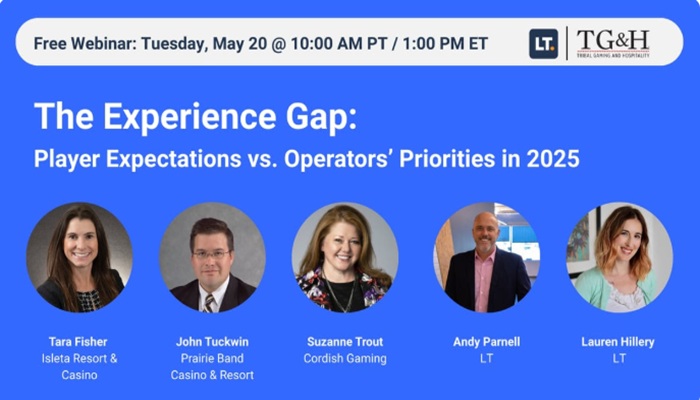
The authors of the research are hosting the webinar “The Experience Gap: Player Expectations vs. Operators’ Priorities in 2025” in partnership with Tribal Gaming & Hospitality Magazine on Tuesday, May 20th, at 10 am PT. They’ll present the highlights of their findings and host a panel discussion. To attend this online meeting, you must register here.