









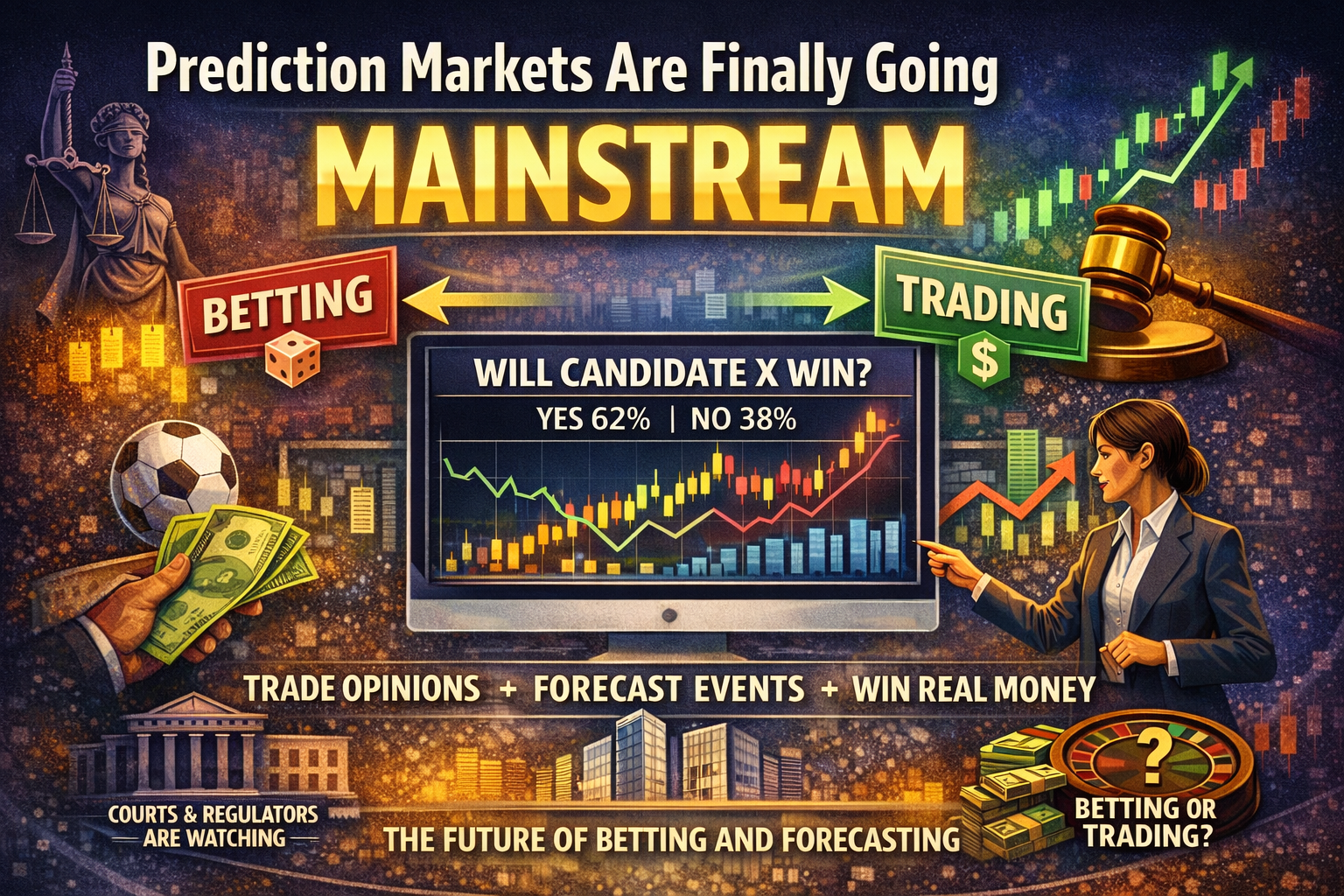
For years, prediction markets have been treated like the strange cousin of the betting world. Not quite gambling. Not quite trading. Something clever, slightly nerdy, and usually ignored until it caused trouble. Now, suddenly, they’re everywhere. Courts are arguing over them. Regulators are circling them. Big money is sniffing around. And what was once dismissed as a fringe experiment is edging closer to mainstream legal status.
That shift reflects a wider change in how people interact with sport, politics, and the future itself. Fans already think in probabilities, form lines, and outcomes, whether they’re following elections, markets, or sport betting Malaysia, where informed choices and smart analysis make the experience more engaging. Prediction markets tap into that same instinct, turning opinions into prices and guesses into tradable assets.
So What Are Prediction Markets, Really?
At first glance, prediction markets look simple. You buy a contract based on whether something will happen. If it does, you win. If it doesn’t, you lose. But under the surface, they work very differently from traditional betting.
There’s no bookmaker setting odds. No house trying to balance risk. Instead, users trade with each other, buying and selling positions as prices rise and fall. If more people believe something will happen, the price goes up. If confidence drops, it goes down. In theory, the final price reflects the crowd’s collective wisdom.
That idea has fascinated economists for decades. Studies have shown that prediction markets often outperform polls and experts, especially when money is on the line. People tend to think harder when their own cash is involved.
Why the Law Has Always Been a Mess
The problem is that prediction markets sit in a legal no-man’s-land. They look like betting. They feel like betting. But legally, many have argued they’re closer to financial derivatives.
In some countries, gambling laws are strict and tightly controlled. In others, financial speculation is encouraged under regulated frameworks. Prediction markets fall between the cracks. Regulators have spent years arguing over which rulebook applies, often choosing to delay rather than decide.
That uncertainty hasn’t stopped growth. If anything, it’s made the sector more stubborn.
Courts and Regulators Can’t Ignore Them Anymore
What’s changed is scale. Prediction markets are no longer tiny websites run by academics and hobbyists. They now handle serious volume, attract institutional interest, and influence public conversation.
As a result, regulators have been forced to engage. Legal challenges are working their way through courts. Authorities are holding consultations. And instead of automatic bans, there’s a growing recognition that these markets need rules, not erasure.
In some jurisdictions, regulators are openly debating whether existing laws are outdated. That alone marks a major shift in tone.
Big Money Has Smelled Opportunity
Perhaps the clearest sign that prediction markets are going mainstream is who’s getting involved. Major financial players and betting brands are no longer laughing them off. They’re investing, partnering, or building rival products.
Why? Because prediction markets offer something powerful: real-time insight into public belief. That data is valuable. Knowing what millions of people think will happen next has obvious applications far beyond gambling.
Traditional sportsbooks see another advantage. Prediction-style products can reach customers in places where standard betting faces legal barriers. It’s innovation driven by regulation as much as technology.
Fans Love the Feeling of Beating the Crowd
For users, prediction markets scratch a particular itch. This isn’t about backing a favourite team out of loyalty. It’s about spotting value before everyone else does.
If you believe the market has misjudged an outcome, you can act on it. And if you’re right, you profit. That sense of “I knew it” is powerful, especially for fans who enjoy analysis more than pure chance.
It’s closer to trading shares than placing a bet. Timing matters. Information matters. Confidence matters.
Why Traditional Betting Is Nervous
Not everyone is thrilled. Sports leagues, regulators, and licensed betting operators worry prediction markets could undermine carefully built systems.
Their concerns are simple. Gambling laws exist to protect consumers, prevent abuse, and collect taxes. If prediction markets offer betting-like products without those safeguards, it creates an uneven playing field.
There’s also the fear of loopholes. If sports outcomes can be traded under financial law, what stops everything becoming a “market” rather than a bet?
The Big Question: Gambling or Trading?
This is the heart of the debate. Is buying a contract on a football result fundamentally different from placing a bet on it?
Supporters argue yes. They say prediction markets are about price discovery and information aggregation, not entertainment. Critics argue that for most users, the experience feels exactly like betting, regardless of legal labels.
The truth probably sits somewhere in between. And that’s why many experts believe prediction markets will end up with their own regulatory category.
Technology Has Changed the Game
A decade ago, regulators worried prediction markets couldn’t be controlled. Today, that argument looks weak. Modern platforms can verify identities, monitor behaviour, and flag risky patterns just as effectively as betting sites.
Some even go further, using transparent ledgers and real-time reporting. The tools exist. What’s been missing is legal clarity.
As technology improves, resistance based on practicality fades. Regulation becomes a question of policy, not possibility.
Beyond Sport and Politics
Prediction markets aren’t limited to football matches or elections. They’re already being used to forecast inflation, interest rates, box office results, and even weather patterns.
Companies use internal markets to predict sales and project timelines. Governments quietly study them as potential forecasting tools. This broader usefulness strengthens the case for legal acceptance.
If markets can help decision-makers see the future more clearly, banning them outright starts to look counterproductive.
What Legal Acceptance Would Actually Mean
Mainstream legal status wouldn’t mean chaos. It would likely come with clear limits. Certain topics might be restricted. Stake caps could be imposed. Licensing requirements would follow.
But clarity would unlock growth. Investors would commit. Platforms would innovate. Users would gain protections instead of uncertainty.
Most importantly, the constant threat of shutdown would disappear.
The Road Ahead
Prediction markets aren’t asking for special treatment anymore. They’re asking for definition. Lawmakers are slowly realising that ignoring them won’t make them disappear.
Whether through courts or legislation, answers are coming. And when they do, prediction markets could become a permanent fixture alongside sportsbooks and financial exchanges.
They won’t replace traditional betting. They won’t replace trading. But they’ll sit somewhere in between, offering something new.
And after years of being treated like an odd experiment, prediction markets are finally stepping into the spotlight — not as a problem to be crushed, but as an industry to be understood.