










By Damian Martinez, journalist at G&M News.
The industry of video games continues to grow and change, along with its players. The ecosystem is resilient, as are its developers. With over 3,000 game developers surveyed, the Game Developers Conference’s 2025 State of the Game Industry report delivers insight into key factors that are shaping the industry.
PC development has skyrocketed, more studios are prioritizing game accessibility, unionization support holds steady, and Hollywood continues to see the value in adapting games for the big (and small) screen. This year, Omdia and the GDC asked the industry workers several questions to understand more about the market.
The developers of 2025
While the industry remains largely white and male, a few key data points show how the developer community is becoming more diverse. Gender diversity in the game industry has seen a notable shift over the past few years. Women and non-binary developers now make up 32% of game developers, compared to 29% last year and 24% in 2022. Men still make up two-thirds (66%) of developers.
However, that number was 75% in 2020, meaning we’ve seen a 9-point change over the past five years. LGBTQ representation among developers has also increased, with one-fourth of respondents identifying as LGBTQ+ (up from 21% in 2024). Nearly half (43%) of 18 to 24-year-old developers identify as LGBTQ+, and women developers are almost four times more likely than men to do so.
The industry has also seen a change in racial and ethnic diversity in the game development community since last year, though it’s a little more difficult to quantify, as many of the changes are too small to draw conclusions. According to the survey done by GDC, 16% of developers are East, South, or Southeast Asian, one-tenth are Hispanic, Latino, or of Spanish origin, and 3% are Black, African, or Caribbean. The combined increases did manifest in a year-over-year decrease in the number of respondents identifying as White or Caucasian, going from 64% in 2024 to 59% today.
The developer’s role
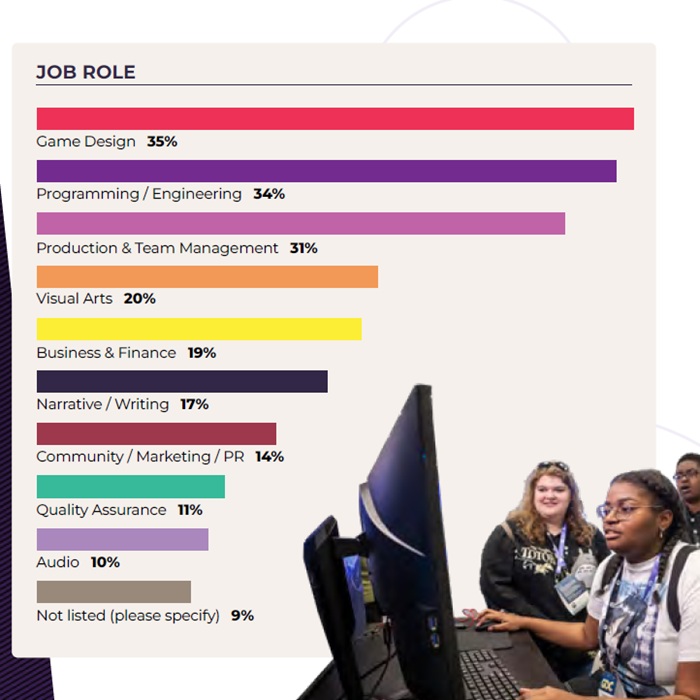
The breakdown of job roles in the game industry has remained consistent. The top roles are in game design, programming, and production and team management, like 2024. The majority of respondents (59%) is either solo developers or work for studios that are the primary developers of their games.
When it comes to job roles, newer developers are more likely to have careers in game design, while those with more experience tend to favor production and team management. Game narrative jobs have seen the most year-on-year growth, going from 14% of developers in 2024 to 17% of them today.
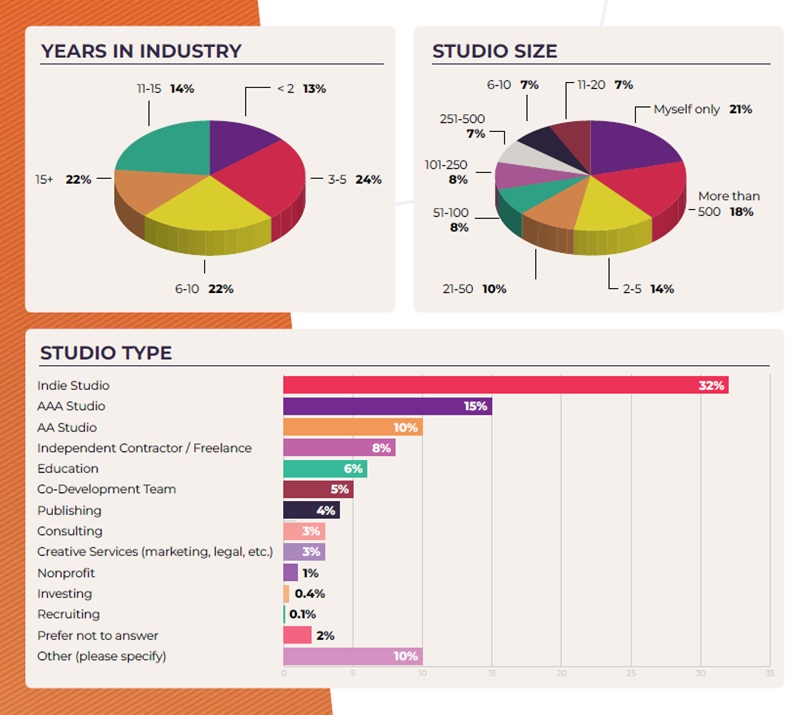
Currently, 60% of game developers report having 10 years or less experience in the industry. That’s up from 56% last year and 57% the year before that. There has been a shift in the number of respondents who are working as solo developers, increasing from 18% in 2024 to 21% today. In fact, there are now more developers working alone than there are developers at studios with over 500 people.
The percentage of respondents who work at indie studios or AA studios has not changed, but the industry has seen a decrease in AAA studio representation, going from 18% in 2024 to 15% today. Of those AAA developers, almost half of them work at companies with over 250 employees, while over half of indie developers work for companies with 20 people or fewer.
Generative AI
Over the past year, Generative AI has shifted from a concept into a common tool. Investors are pumping billions of dollars into AI companies, studios are busy developing their own proprietary tools, and AI-generated content has a robust foothold in search engines, social media platforms, and advertisements.
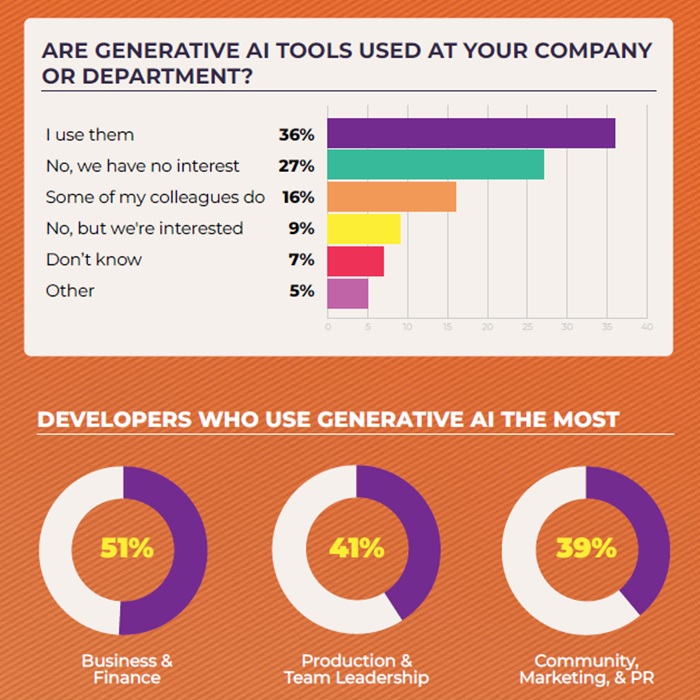
The game industry is not immune to this change. According to the survey, a majority (52%) of developers work at companies where Generative AI tools are being used. One-third (36%) of developers express they use them personally, up from 31% last year. But it appears that as usage has gone up, curiosity has gone down. Less than one-tenth (9%) of developers comment their companies are interested in Generative AI tools, down from 15% last year.
In comparison, 27% say their companies have no interest in using them, a 9-point increase from 2024. When asked what applications they saw for the use of Generative AI in the game industry, developers pointed to tasks like coding assistance, concept art and 3D model generation, and automation of repetitive tasks (developers made similar suggestions in our 2024 survey). However, the word used most frequently in their responses was “none.”
As game developers have adopted Generative AI, employers have expanded policies regulating its usage. Almost two-thirds (64%) of developers indicate they work at companies with some form of internal policy for Generative AI use, up from 51% in 2024. That amount increases to 78% for developers at AAA studios.
The industry has seen a more substantial rise in the number of developers whose companies allow optional use of Generative AI tools, along with companies that don’t allow them to be used at all. The number of developers who say they’re required to use Generative AI tools on the job doubled, though it’s still only at 4%.
Passion for PC development explodes
Every year, the GDC asks developers to share what platforms they’ve been making games for, and which ones they plan on supporting in the future. PC has consistently been the platform of choice, but this year saw its dominance increase even more: 80% of developers said they’re currently making games for PC (up from 66%), and three-fourths (74%) responded the platform is of interest to them (up from 62%).
The exact reason for this jump is unclear, but it could be connected to the rising popularity of Valve’s Steam Deck. This year’s survey didn’t single out Steam (or Valve’s handheld gaming computer) as its own platform, because it’s a hub for PC and Mac games. It appears some developers do view it as a unique platform. For example, when asked to name other platforms that interest them, almost half (44%) wrote in Steam Deck.
PlayStation continues its console lead over Xbox. About 38% of developers is currently making games for PS5 hardware (compared to 34% for Xbox Series X/S), and 37% is turning to PlayStation for their next projects (compared to 33% for Xbox). However, Xbox is outperforming PlayStation in one area: cloud services. Besides, 13% of developers is making games for Xbox Game Pass, compared to 9% for PlayStation Plus (Extra or Premium).
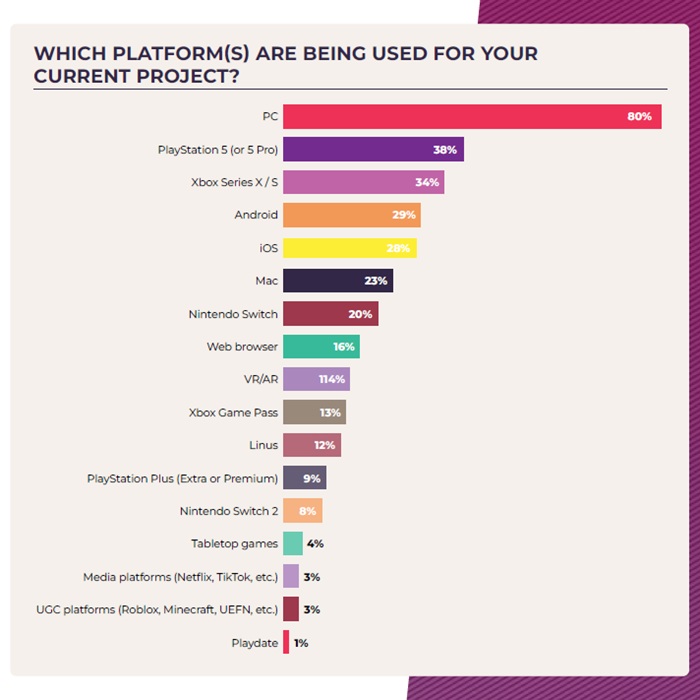
Mobile game development has increased for the first time since 2020, with 29% of developers making games for Android and 28% for iOS (up from 24% and 23%, respectively). Much of that is in Brazil and the East and South/Central/West Asia regions, where over half of developers say they work on mobile games. The biggest surprise this year might be browser games. According to the survey, 16% of developers is working on releases for web browsers. That’s up from 9% last year and 11% the year before. It’s actually the highest percentage of developers the industry has seen working on web browser games in a decade.
On the other hand, 35% of all game developers work in VR/AR development. The number of developers working in virtual and augmented reality has stayed consistent, as have the platforms of choice. According to the survey, the Meta Quest/Horizon Store remains the dominant space for VR/AR developers, with 59% currently making games for the platform.
This is followed by Steam VR (31%) and PlayStation VR/VR2 (16%). Although only 8% of VR/AR developers is currently making games for Apple visionOS, the platform looks to be growing its foothold. Almost one-fifth (18%) of respondents say their next games will be on the platform, and one-fourth are interested in Apple’s VR headset.
Readers can download this document here.