









More than a year has passed since Part 2 of this series examining the technologies behind Class II, Class III, and VLT gaming in tribal casinos. Before that, in Part 1, I considered the evolution of commercial casinos in the United States. While the delay was longer than planned, a consequence of professional commitments and shifting priorities that demanded my full attention, the time was not wasted. The U.S. gaming landscape has continued to develop at a remarkable pace, and the topics we will explore in this final installment, state lotteries and online gambling, have only grown in relevance and complexity. With that in mind, I am pleased to present the third and concluding part of this series, which I trust will be well worth the wait.
Types of Traditional Lottery in the United States
In the United States, lotteries are operated independently by 48 jurisdictions (45 states, the District of Columbia, Puerto Rico, and the U.S. Virgin Islands) and there is no single national lottery organization. However, consortiums of state lotteries jointly organize games that span larger geographical footprints, which in turn generate larger jackpots and serve as de facto national games. While game offerings vary by jurisdiction, most state lotteries feature a common set of product categories that have been tested, refined, and validated over decades. These traditional lottery formats can be grouped into several distinct types, each with its own game mechanics, draw frequency, prize structure, and player experience.
In this article, we will explain the technology behind every one of these available games.
Instant Scratch-Off and Pull-Tab Systems
So, you think that scratch-off is random? Think again. Here’s a fun fact that might blow your mind the next time you’re standing at a gas station counter, furiously scratching away at a lottery ticket with a coin: your fate was already sealed before that ticket was even printed.
That’s right, scratch-off tickets and pull-tabs operate on a completely different logic than the slot machines in Vegas. There’s no cosmic RNG in the sky deciding your destiny in real time. Instead, every single ticket in a print run has already been assigned a winner or loser status in advance, like a giant stack of envelopes where someone already knows exactly which ones have cash inside. A print run is simply the full batch of tickets printed for a specific scratch-off game.
Think of it like printing a book, when a publisher prints 10,000 copies of a novel, that’s a print run. For scratch-off tickets, it works the same way: the lottery prints, say, 5 million tickets for “Game #247: Lucky 7s,” and that entire batch is the print run.
Retailers can hold tickets for days before selling them, so without serious protection, a clever bad actor could identify winners and quietly pocket them. To prevent this, manufacturers load tickets up with aluminum foil barriers, solvent-reactive dyes that bleed all over the data if you try to tamper with them, luminescent security markers, and encrypted serial numbers. Basically, these little USD 2 tickets have more security layers than some bank documents.
What Is a Pull-Tab? The Underrated Cousin of the Scratch-Off
If scratch-off tickets are the glamorous, nationally advertised face of lottery gaming, pull-tabs are the scrappy, beloved regulars you find at your local bar, bingo hall, or VFW lodge.
A pull-tab is a small, thick paper ticket with several perforated windows, little flaps you tear open (or “pull”) to reveal symbols underneath. Match the right combination of symbols and you win. No coin-scratching required, just your fingers and a little hope.
They’re usually small, cheap (often USD 1–2), and fast to play. You can go through a handful in under a minute, which is part of their appeal in social settings like bars and charitable gaming nights.
Pull-tab tickets actually come with a scoreboard showing exactly how many big prizes are left in the batch. So, when someone says, “the next one’s got to be a winner,” for once in gambling history… they might actually be right.
The Digital Glow-Up
Both products have become increasingly popular, bringing the same finite-outcome model to tablet devices and kiosks. Regulators are careful to ensure these don’t look or feel like slot machines (no spinning reels, no casino-style animations), keeping them firmly in the “lottery” category both legally and in spirit.
YOUR GUIDE TO LOTTERY DRAW GAMES
Daily Numbers Games: The Grinder’s Lottery
Pick 2, Pick 3, Pick 4, Pick 5… these are the workhorses of the lottery world. They’re the lottery equivalent of a regular at the diner, not flashy, but always there.
The gameplay is surprisingly flexible. You can bet the exact order of numbers (a “straight” play, harder, pays more) or just that the right numbers show up in any order (a “box” play, easier, pays less). It’s one of the few lottery formats where your strategy actually has some nuance to it.
One quirk worth knowing: if too many people bet the same number combination, the lottery just stops taking bets on it. Think of it like a sportsbook closing a line because everyone’s betting on one side. The lottery must protect itself from paying out a fortune because half the state dreamed about 7-7-7 last night.
Lotto: The Classic
This is what your grandma plays. One machine, a bunch of numbered balls, pick five or six and pray. The jackpot is pari-mutuel, a fancy word meaning the prize pool is built from ticket sales, and if nobody wins, it rolls over and keeps growing until someone does. That rollover mechanic is the secret sauce behind the truly insane jackpots.
Powerball & Mega Millions: Organized Chaos at National Scale
These are the rock stars. Powerball is run by a consortium of state lotteries called MUSL (formed in 1988), and Mega Millions has been around since 1996. Thanks to a 2009 deal, both are now available in almost every state.
The key to their monster jackpots is the two-field format, you pick numbers from one pool, then pick a bonus number (the Powerball or Mega Ball) from a separate, smaller pool. This design cranks the odds way up, which means jackpots roll over more often, which means they grow into the kind of numbers that make people do math they never do otherwise.
The record? A jaw-dropping USD 2.04 billion Powerball jackpot in November 2022. Yes, billion with a B.
A general view
All of these games, from your humble daily Pick 3 to a billion-dollar Powerball, generated over USD 113 billion in U.S. sales in fiscal year 2024 alone. That money funds schools, roads, and public programs across the country. So even when you lose, you’re technically winning. Sort of. Kind of. We’ll let you decide.
GAMING ON THE INTERNET
Think about what actually happens when someone places a bet online. In the few seconds between tapping a button and seeing a result, an enormous amount of technology fires in the background. The bet must be placed securely. The odds must be calculated in real time. The player’s identity and location must be verified. The money must move. All of it must happen fast enough that the user barely notices. Internet gambling isn’t just a casino with a website; it’s one of the most technically demanding environments in consumer technology, combining the security requirements of online banking, the speed demands of live sports, and the compliance complexity of a heavily regulated financial infrastructure.
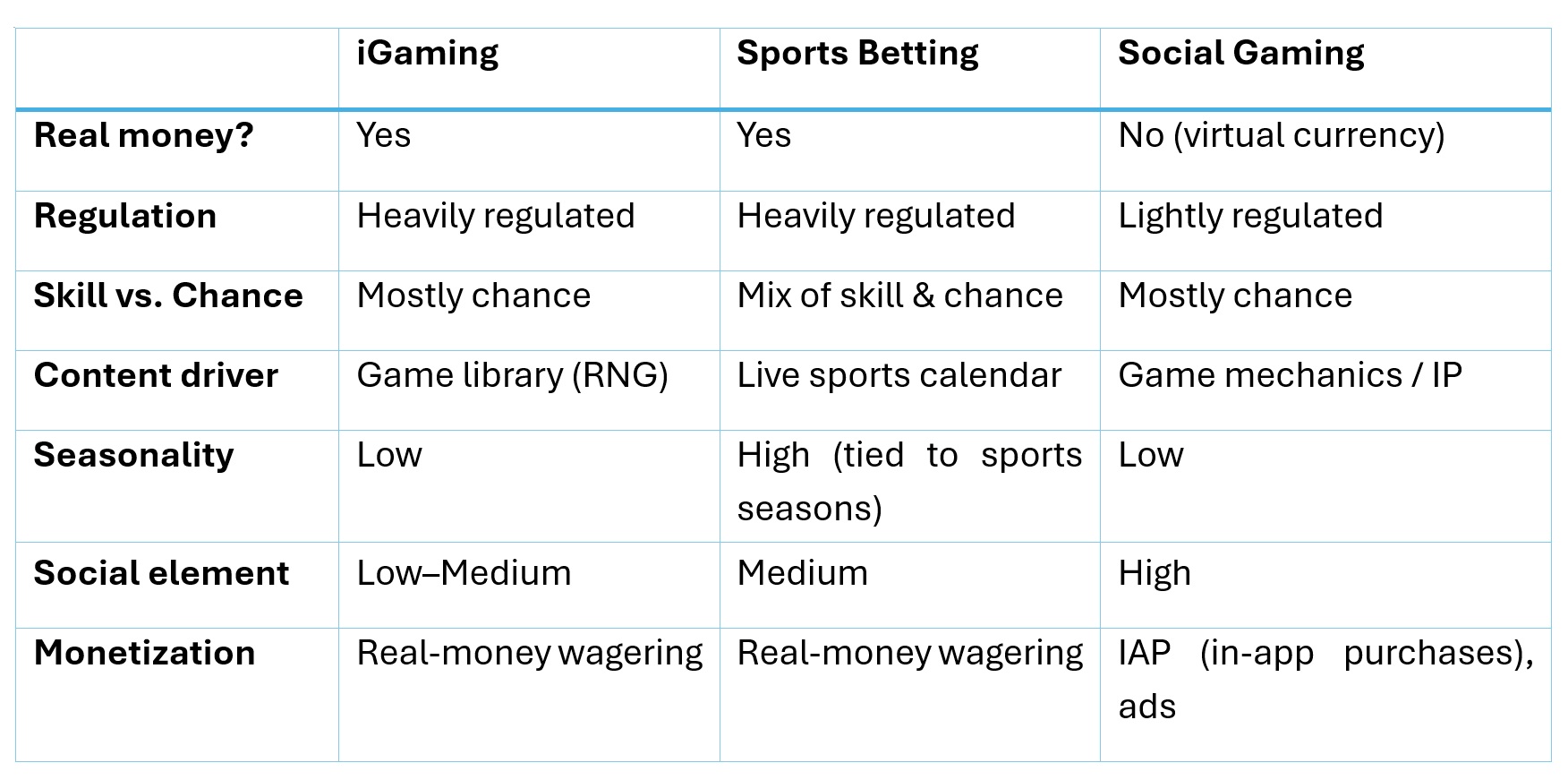
There are three main categories that we will expand on:
- Online Gaming (iGaming): it refers to any interactive gambling conducted online, including online casino games (slots, poker, blackjack, roulette), and often serves as an umbrella that can include sports betting.
- Sports Betting is wagering real money on the outcomes of sporting events. It can exist as a standalone product or as part of a broader iGaming platform.
- Social Gaming: refers to games played for fun, typically on mobile or social platforms, where players use virtual currency rather than real money. Think Zynga Poker, Coin Master, or free-to-play casino-style apps.
What Do They Have in Common?
All three share a surprising amount of DNA:
- Core engagement loops: all three use reward mechanics (wins, streaks, bonuses, near-misses) to keep players engaged and coming back.
- Game formats: slots, poker, and card games appear across all three in virtually identical forms; only the stakes differ.
- Technology stack: mobile-first design, real-time data feeds, personalization algorithms, and push notifications are central to all three.
- User acquisition challenges: all three compete for the same demographic and face high customer acquisition costs and churn rates.
- Loyalty & VIP programs: bonuses, free spins, free bets, and tiered reward systems are common across all three.
Key Differences
THE REGULATORY TAKEAWAY
iGaming
The core takeaway: Heavily regulated, highly fragmented, and permission based.
iGaming is the most tightly controlled of the three. Because real money changes hands on games of pure chance, regulators treat it similarly to a physical casino. Key principles:
- Licensing is mandatory and jurisdiction specific. An operator must obtain a license in virtually every market they want to operate in. There is no “one license fits all”. A Malta Gaming Authority (MGA) license doesn’t let you operate in New Jersey, for example.
- In the US specifically, iGaming is only legal in a handful of states (New Jersey, Pennsylvania, Michigan, Connecticut, Delaware, West Virginia, Rhode Island). Each state has its own regulatory body, tax rate, and compliance requirements.
- Consumer protections are extensive, operators must enforce responsible gambling tools (deposit limits, self-exclusion), verify player identity (Know Your Customer or KYC), prevent underage gambling, and comply with AML (anti-money laundering) rules.
- Game integrity is regulated too. RNG (random number generator) software must be certified by approved testing labs (e.g., GLI, BMM).
- Advertising is restricted in many jurisdictions, with rules around targeting, messaging, and mandatory responsible gambling disclosures.
Bottom line: If you want to operate iGaming, you need deep compliance infrastructure, state-by-state licensing, and ongoing regulatory relationships. The barrier to entry is high by design.
Sports Betting
The core takeaway: Rapidly expanding but still fragmented and politically charged.
Sports betting has undergone a dramatic regulatory shift since the US Supreme Court’s 2018 Murphy v. NCAA decision struck down PASPA, opening the door for states to legalize it individually.
- US state-by-state legalization is still unfolding. As of now, roughly 38 states plus DC have legalized sports betting in some form, but the rules vary enormously, some allow mobile/online only, some require a tethered relationship to a physical casino, some restrict certain bet types.
- The federal void matters. There is no federal framework governing sports betting in the US, which creates inconsistency and compliance complexity for operators working across multiple states.
- Integrity concerns are unique to sports betting, regulators require operators to share data with sports leagues, flag suspicious betting patterns, and in some jurisdictions restrict betting on certain events (e.g., in-state college teams, prop bets on college athletes).
- Taxation varies wildly, state tax rates on gross gaming revenue range from as low as 6.75% (Nevada) to as high as 51% (New Hampshire, New York), which significantly affects operator economics.
- Internationally, markets like the UK (regulated by the UKGC), Australia, and much of Europe have mature, established frameworks. The US is essentially playing catch-up.
- Responsible gambling obligations mirror iGaming. KYC, self-exclusion, and advertising standards are all required in licensed markets.
Bottom line: Sports betting is in a growth and normalization phase regulatorily. The opportunity is large, but operators must navigate a patchwork of state laws, and the political dynamics (leagues, broadcasters, lawmakers) add complexity that pure iGaming doesn’t have.
Social Gaming
The core takeaway: Largely unregulated today, but under increasing scrutiny.
Social gaming occupies a privileged regulatory position because no real money is wagered, virtual currency isn’t considered legal tender, so traditional gambling laws generally don’t apply. However, that’s changing.
- Not classified as gambling in most jurisdictions; the key legal distinction is that players can’t cash out real money, so the activity falls outside gambling statutes.
- Loot boxes are the flashpoint. Regulators in Belgium, the Netherlands, and parts of Asia have classified certain loot box mechanics as gambling, forcing developers to remove or alter them. The UK and US have studied the issue but haven’t acted decisively yet. A loot box is a virtual item in a video game that contains a randomized selection of rewards. You pay (with real money or in-game currency) to open it, but you don’t know what’s inside until after you’ve purchased it. Think of it like a digital mystery box or a pack of trading cards: you know the possible contents, but the specific outcome is random.
- Sweepstakes casinos are the gray zone. These platforms use a dual-currency model (free coins + sweeps coins redeemable for prizes) that is structured to comply with US sweepstakes law rather than gambling law. It’s legal in most US states today, but operators are aware that regulators could move to close this gap, and several states (e.g., Idaho, Michigan, Washington) already restrict or ban them.
- Children and minors are a growing concern. Social games with gambling-like mechanics (slots, card games) are accessible to minors with no age verification required, which is drawing regulatory attention.
- Data privacy is the most active regulatory pressure point today: COPPA (children’s data), GDPR (General Data Protection Regulation), and CCPA (California Consumer Privacy Act) all apply to social gaming platforms. Several other states (Virginia, Colorado, Connecticut, Texas) have now passed similar laws, accelerating this into a nationwide patchwork.
- No formal responsible gambling requirements exist in most markets, though some platforms voluntarily implement spend limits and wellness tools to get ahead of regulation.
Bottom line: Social gaming has enjoyed a regulatory free pass for years due to the no-real-money distinction, but that window is narrowing. Sweepstakes models in particular are on borrowed time in some jurisdictions, and any operator building in this space should be designing for a more regulated future.
THE BIG PICTURE
The overarching trend is that regulators are playing catch-up with technology. All three industries have largely grown faster than the laws designed to govern them. The next 5–10 years will likely bring:
- Stricter social gaming oversight, possibly reclassifying some products as gambling
- More interstate coordination on sports betting standards
- Heavier focus on protecting young and vulnerable users across all three
The Convergence is Already Here
The story of gambling technology in the United States is no longer a story about distinct industries operating in separate lanes. iGaming, sports betting, and social gaming have spent the last decade borrowing from each other; sharing mechanics, competing for the same users, and increasingly appearing on the same platform under the same brand.
What began as a fragmented landscape of state-by-state lotteries and brick-and-mortar casinos has transformed into a sophisticated, always-on digital ecosystem that fits in every American’s pocket. Technology has moved quickly. The regulatory frameworks governing it, in many cases, have not.
That gap matters, not because the industry is inherently harmful, but because well-designed regulation is actually what allows technology to operate at its full potential. Legal, licensed markets consistently outperform unregulated ones on consumer protection, responsible gambling infrastructure, and tax compliance. Outdated frameworks don’t slow the technology down. They simply push activity toward less accountable corners of the market.
The current patchwork of state-by-state laws, legacy statutes written before smartphones existed, and regulatory bodies still defining their own mandates creates real friction, for operators trying to build compliant products, for consumers who deserve consistent protections regardless of what state they live in, and for regulators themselves who are being asked to oversee technologies they had no hand in shaping.
United States’ gambling industry is no longer an exception to the digital economy. It is part of it. Like every other sector where technology has outrun policy (financial services, social media, data privacy), the question is not whether to regulate, but whether to regulate thoughtfully and proactively, or reactively and too late.
The chips are on the table. The question is who’s watching the game?