









Can you tell your career story at the company?
I joined 1spin4win shortly after its founding, so it’s been over four years now. Our recent anniversary was on May 14th. Since then, I’ve been leading the art studio for the project, and I’ve had the opportunity to influence the quality of the games we produce, their concepts, and the overall atmosphere.
What is your professional background in game development and specifically in the iGaming industry?
Before joining 1spin4win, I had the opportunity to work at four different product companies dedicated to creating online slots. My professional specialization is quite focused, which allows me to dive deep into the casino industry, building on the experience I’ve gained over the years.
Can you recall how did you enter the slots industry, and what do you find most exciting about it?
It’s quite a funny story. Before entering the casino industry, I was a professional airbrush artist, painting motorcycles, cars, doing some design work, and body art. I even won some competitions! One day, a client approached me for a small car painting project. Later, a friend of this client saw my work and asked me to create themed illustrations on paper. I completed the request, of course, using airbrush techniques on large paper. At the time, I never imagined those illustrations would later become symbols in a slot game! Eventually, I received an offer to join a slot provider as an artist, and that’s how my journey in the industry began. What I find most exciting about the slots industry is that no two games are ever the same. There’s such a wide variety of styles, ideas, and approaches. The casino industry is dynamic, highly competitive, and fast-growing, with an annual growth rate of 8%. Since we create games for players, there are a lot of factors to consider before releasing a slot, which makes every project interesting and challenging.
How did the idea of creating a Japanese-themed slot series come about, and why was this particular theme chosen for the visual concept?
The idea came from the unique charm of traditional Japanese culture, which has a particular mystery and refinement. It combines strong traditions, Eastern philosophy, aesthetics, and pursuit of perfection. That’s why we chose a Japanese theme for our slot, Tiger’s Steps Hold and Win, inspired by the ninja culture. We elaborated characters, a clan, and a Master not just for storytelling, but also to give the artists a deeper base for creativity and to make it easier to dive into the atmosphere. As often happens, once we started, we got even more inspired and decided to continue exploring the theme with a second game, Gentle Fox Hold and Win. This slot introduced a new, intriguing female character, with a different mood, color palette, and story. That’s when a new idea came up, something we noticed haven’t been done before: to build a series of games connected by a shared storyline, like a mini-series, so players could look forward to each new release. It also gave us a great angle for promoting the games. The team supported the idea, and we started working even more closely on the project. This led to the development of the third and fourth slots in the Japanese series. When you play one, you naturally discover the others too.

In which way is possible to adapt authentic Japanese aesthetics for a broad international audience?
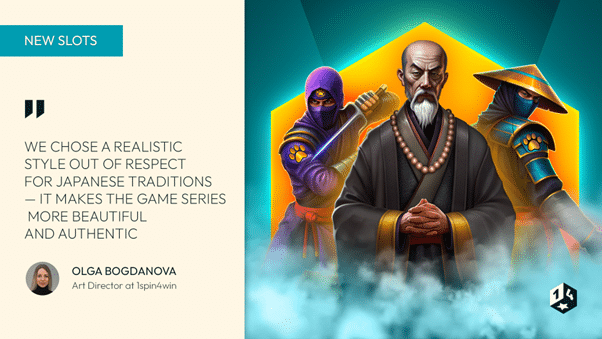
We created a commercial version of the Japanese theme for 1spin4win’s slots. Our details aren’t meant to be as historically accurate as a museum exhibition, but our main goal is to build a world that any player can easily understand and connect with. At the same time, traditional Japanese themes don’t leave much room for big changes or distortions. That’s why we chose a realistic style that shows respect for Japanese traditions. It’s not only the right approach, but it also makes the games look more beautiful and authentic.
How is the overarching storyline of the series structured, and how is it embedded in each game?
The series’ overarching storyline follows a continuous narrative set in a medieval Japanese village near Mount Fuji. Each game introduces a new chapter with unique characters and evolving conflicts, seamlessly tying into the broader saga. In Tiger’s Steps Hold and Win, players are immersed in the lives of two ninja apprentices, Murasaki and Koniro, who defend ancient scrolls from the shogun’s forces. The story evolves in Gentle Fox, where players encounter Tomoko-hama, a mysterious and manipulative woman who entices players into her dangerous games. Way of Honor shifts focus to noble samurai, Mizuiro and Midoriiro, defending the shogun’s peace, emphasizing loyalty and bravery. The fourth game connects the dots, offering players a choice between key characters -ninja, samurai, or the Gentle Fox- allowing them to shape the outcome of the story. Each game builds upon the last, creating a narrative-driven experience across the series.
Does the art style evolve with each new release? How do you maintain visual consistency along the series?
It’s very important for us to keep a consistent style across the entire Japanese slot series so that all the games feel like part of one harmonious world. To make sure of that, we made a conscious decision to assign the entire series to one artist. This way, we avoid any stylistic or color mismatches and keep a strong, unified look throughout the games.
Do you personally play casino games, and if so, do you ever play the games you’ve helped create?
The last time I played casino games was European roulette at a local casino in my city. Luckily, I have strong self-control and always know when to stop. Personally, I see casino games more as a source of entertainment and professional interest than a way to make money. However, I do enjoy observing players, seeing what choices they make and how they react to the experience. I believe that great slot art doesn’t always equal a great product. Game graphics are just the cover; what matters is the balance of all the elements working together. As I mentioned earlier, balance keeps players engaged in the long run. It’s not always easy for me to play games I’ve worked on, as I tend to notice areas where I could’ve done something differently or improved the design. I don’t know how other Art Directors feel, but it can be a bit frustrating for me. Still, all these observations go into my personal experience, and with every new game I create, I become more skilled and professional. Analyzing my work is a big part of what helps me grow in my role.