









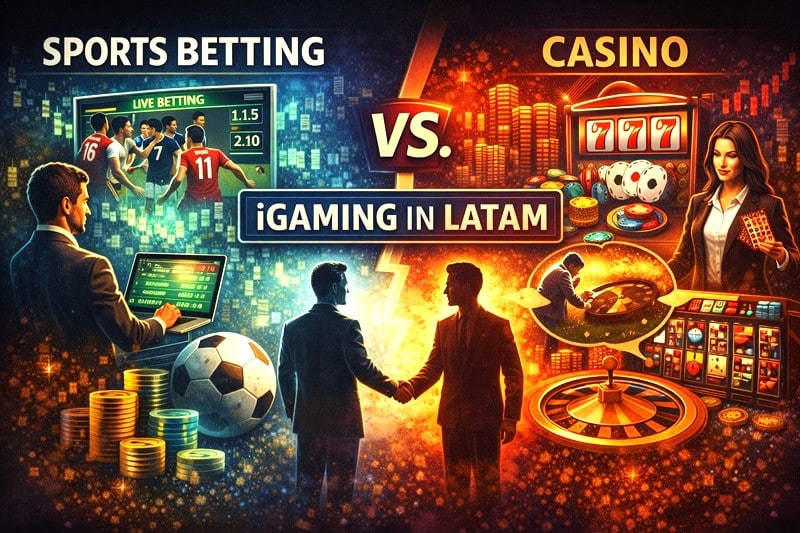
At the core of every iGaming operator, there is an unspoken tension -sometimes even an open conflict- over resources, priorities and vision: sports betting versus casino.
They are two distinct worlds. Different cultures, technologies, KPIs, and even different professional profiles. One talks about odds, leagues and jerseys; the other, about slots, free spins and engagement loops.
As an executive who has managed both sides of the business, I have seen this debate countless times in boardrooms:
“Do we invest more in sports sponsorships or in exclusive casino content?”
“Do we hire a trader or a casino CRM specialist?”
The fundamental question every CEO should ask is not which vertical is better, but whether the company is managing two disconnected businesses or a portfolio of complementary products. In Latin America, this distinction defines who wins and who stalls.
SPORTS BETTING: THE MASS ENTRY POINT AND THE PROFITABILITY ILLUSION
Let’s address an uncomfortable truth: sports betting is a powerful acquisition engine, but a low-margin business. In Latin America, it is the gateway for nearly 80% of new players, driven by cultural passion rather than brand loyalty.
Key advantage: Mass acquisition.
A national derby or an international tournament acts as organic marketing. Visibility explodes and registrations spike impulsively.
The challenge: Sports bettors are transactional. They follow teams, not brands. A slightly better odd elsewhere and they are gone. Lifetime Value (LTV) is limited, while Cost Per Acquisition (CPA) remains high due to intense competition for licenses, sponsorships and media exposure.
CASINO: THE MARGIN ENGINE, WITH BARRIERS TO ENTRY
Casino is the vertical that quietly sustains the business. It generates margins, retention, and long-term value.
Key advantage: Retention and profitability.
Casino players build habits. They connect with specific games and, over time, with the platform itself. Their LTV can be three to five times higher than that of a sports-only bettor.
The challenge: Acquisition is harder. Casino lacks the immediate cultural hook of sports and faces higher stigma. Success requires better storytelling, creative bonuses, influencer strategies and gamification.
THE FALSE DICHOTOMY AND THE REAL OPPORTUNITY: THE HYBRID PLAYER
Treating sports betting and casino as isolated silos is the biggest strategic mistake operators make. The real opportunity lies in cross-selling intelligently to create the hybrid player.
A user who places a bet on a major match and, during halftime, plays a few spins is the most valuable customer an operator can have.
A 3-STEP FRAMEWORK TO ALIGN BOTH VERTICALS
Step 1: Use Sports as an Attraction Funnel
Sport is the hook, not the destination. Registration for a match should open the door to casino discovery, not end at a betting slip.
Step 2: Build Contextual Bridges
Cross-selling must feel natural, not forced. Sports-related casino mechanics, themed tables or reward systems tied to match outcomes create organic engagement.
Step 3: Measure What Truly Matters
Move beyond siloed metrics. Compare LTV of hybrid players versus single-vertical users. This data changes internal conversations and aligns leadership around a unified strategy.
CONCLUSION: THE PLATFORM ALWAYS WINS
The winners of the next decade will not be defined by better odds or newer games. They will be defined by seamless experiences. I’m referring to platforms where sports and casino coexist as one entertainment ecosystem.
The real leadership challenge is ending the internal cold war. When sports and casino leaders share the same objective -maximizing total player value-, the company stops competing with itself and starts scaling sustainably across Latin America.