









By Tatiana Martins, journalist at G&M News.
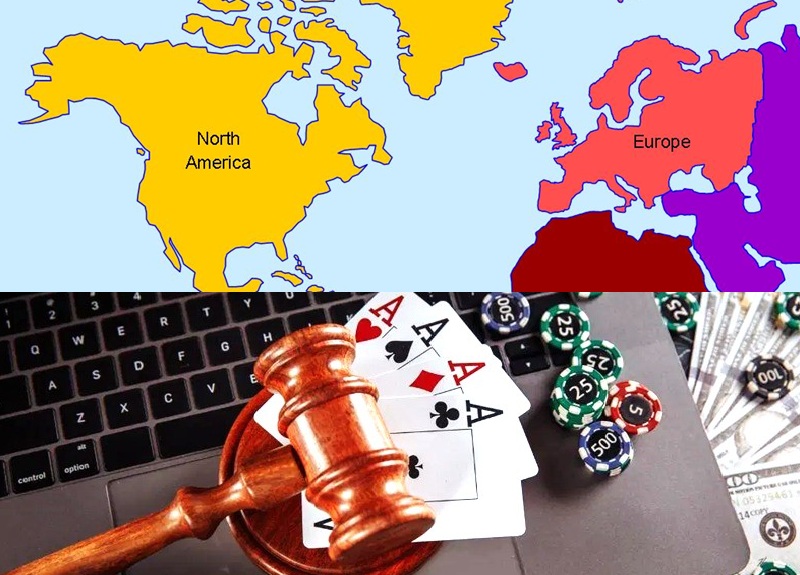
Driven by regulatory shifts and digital adoption, the iGaming sector is undergoing rapid global transformation, but Europe and North America are developing along notably different trajectories. Europe represents a mature, highly regulated, and fragmented environment, whereas North America is scaling up fast, driven by fresh legislation and investment. For B2B operators, understanding these contrasts is essential to navigating each region’s unique business landscape and unlocking new growth opportunities.
- MARKET MATURITY AND REVENUE SCALE
Europe has long been a pioneer in iGaming. According to a 2024 analysis by Atlaslive, the region reached a record €123.4 billion in gross gaming revenue (GGR), a 5% year-over-year increase. In North America, the online gambling market is expanding at a faster rate. Following Research and Markets, the sector is expected to reach USD 29.38 billion by 2030, with a projected compound annual growth rate (CAGR) of 12.3% from 2024 to 2030.
- REGULATORY LANDSCAPE
Europe’s regulatory framework is decentralized. Each country imposes its own rules, often creating challenges for cross-border operators. For instance, Germany applies strict advertising rules and stake limits, while countries like Sweden and the Netherlands have recently revised their gambling laws to strengthen player protections.
In North America, regulation occurs primarily at the state or provincial level. In the U.S., 39 states, along with Washington, D.C., and Puerto Rico, have legalized sports betting in some form, and 7 (Connecticut, Delaware, Michigan, New Jersey, Pennsylvania, Rhode Island, and West Virginia) allow iGaming. Canada’s Ontario launched a regulated iGaming market in 2022 under iGaming Ontario, becoming a model for streamlined licensing.
- TAXATION AND OPERATIONAL COSTS
European taxation varies widely. The UK Gambling Commission imposes a 21% remote gaming duty, while Germany levies a 5.3% tax on online poker and slot stakes. Additional fees are often required for social responsibility programs.
In North America, taxes differ by state. New York imposes a 51% tax on online sports betting GGR, while New Jersey applies a more moderate 13-15%. Ontario uses a revenue-sharing model that’s considered more favorable to operators.
- LICENSING COMPLEXITY
Europe’s fragmented model means operators must navigate multiple jurisdictions, such as applying for distinct licenses in the UK, Sweden, and the Netherlands. Regulatory updates, such as the Netherlands’ Remote Gambling Act, can also create short-term uncertainty.
North America’s licensing can be rigorous, especially in the U.S., where background checks and partnership requirements are common. However, once licensed, operators benefit from transparent rules and long-term clarity. Ontario’s centralized licensing via iGO is an example of regulatory efficiency.
- MARKET GROWTH AND COMPETITIVE DYNAMICS
Development in Europe has plateaued, with most markets (with the exception of Portugal, which is experiencing huge progress) advancing in single digits. Advertising restrictions and rising compliance costs affect operator flexibility. Markets like the UK are saturated, though newer entrants like the Netherlands offer pockets of growth.
In North America, explosive escalation continues. The U.S. commercial gaming industry achieved a record-breaking USD 71.92 billion in revenue in 2024, marking its fourth consecutive year of growth. The sector rose 7.5% from 2023. With the inclusion of tribal gaming, total U.S. gaming revenue was USD 115 billion in 2024. For its part, in Canada, Ontario reported over CAD 2.4 billion in GGR during its first full year of regulation (iGaming Ontario). Players like FanDuel, DraftKings, and BetMGM dominate thanks to deep investment in marketing and tech.
- TECHNOLOGY AND INNOVATION
European operators lead in areas like AML (Anti-Money Laundering) compliance, self-exclusion schemes, and mobile-first platforms. Malta’s MGA license is a global standard for innovation-friendly regulation.
North America excels in user experience innovation. Live betting, micro-betting, fantasy sports integration, and partnerships with major sports leagues fuel engagement. U.S. operators are increasingly leveraging AI and real-time data for personalized promotions and risk management.
For B2B providers, the contrast between Europe and North America reveals unique strategic priorities. Europe, with its mature and highly regulated markets, offers consistent demand for compliance, AML, and risk management solutions. Meanwhile, North America’s fast-growing landscape is ideal for companies focused on gamification, marketing tech, and real-time data tools.
Understanding the pace, regulatory environments, and consumer behavior in each region is key to making informed business decisions and capitalizing on the most promising opportunities.