








By Tatiana Martins, journalist at G&M News.
urrently, in a global iGaming landscape defined by diverse and rapidly changing laws, geofencing technology has emerged as an indispensable tool. For operators, it provides a way to enforce regulatory boundaries, prevent revenue leakage, and enhance player security. Beyond compliance, geofencing presents opportunities: smoother market entry, differentiated user trust, and smarter risk control.
Below, we explore how geofencing is shaping regulation, player mobility, and what operators should do to turn invisible boundaries into visible advantages.
What is geofencing or geolocation compliance
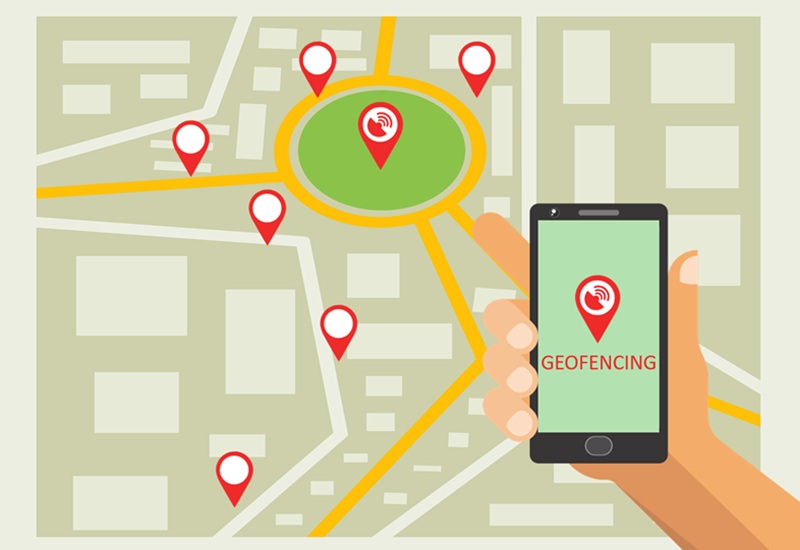
Geofencing creates virtual boundaries (state lines, country borders, or even finer perimeters) using GPS, WiFi, cellular data, and sometimes device fingerprinting. When a player moves into or outside a permitted area, access can be allowed, blocked, or adjusted.
Many jurisdictions require operators to ensure players are physically located within authorized territories at all times (or during wagering/deposits). Geolocation solutions also often need to detect attempts to spoof or fake location (via VPNs, proxies, GPS manipulation).
Regulatory and geopolitical implications
- Fragmented Jurisdictions Require Precision
Each legal region (e.g. state, province, country) can have distinct rules: what games are permitted, where promos are allowed, which age rules apply, and even how strong identity/location verification must be. Geofencing allows operators to dynamically adapt: they can enforce different rules depending on where a player is, rather than one-size-fits-all.
- Border proximity & Edge-Case Risk
Players near jurisdiction lines (e.g. U.S. states, or European countries) challenge systems: a few meters of error could allow illegal play. Regulators expect “apartment-level” or “building-level” accuracy in many mature markets. For example, Incognia’s geolocation solution is certified by GLI and claims apartment-level accuracy plus tamper-resistance.
- Legal Proof & Audit Trails
In regulated markets, operators may need to prove in audits or legal settings that geolocation was enforced correctly. Robust data logs, detection of spoofing, device security checks (rooted or jailbroken devices), and continuous re-verification are increasingly demanded.
- Geopolitical Risk & Changing Laws
Some states or sub-national areas are changing laws quickly (banning some betting, changing licensing, expanding/restricting offerings based on location). For instance, Tamil Nadu in India has imposed bans that require geofencing to ensure compliance.
- Player Mobility & Cross-Border Enforcement
The more mobile and connected players are (travel, VPN use, remote work), the more friction geofencing introduces. It also gives operators tools to safeguard from illegal play, bonus abuse, fraud, and regulatory penalties.
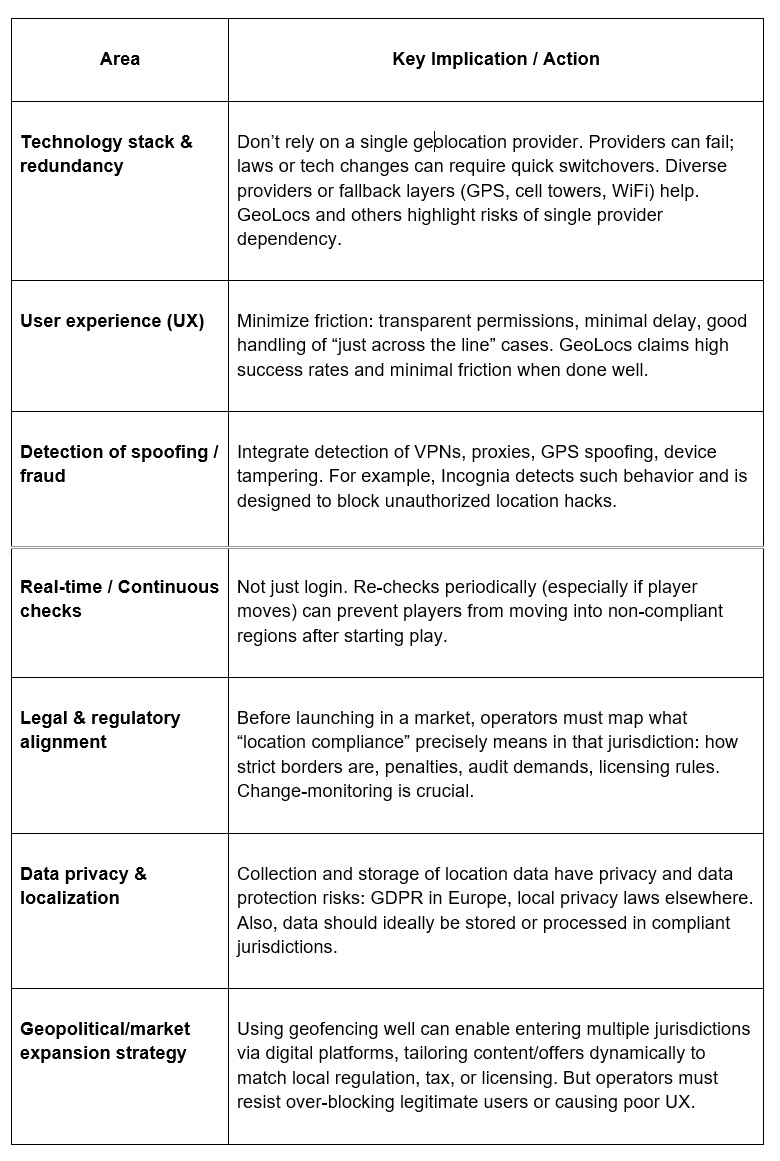
Practical issues and best operational actions
To gain advantage (not just avoid risk), operators should treat geofencing as a core part of strategy, not merely a technical hurdle.
Case studies
- Incognia: Launched a geolocation compliance & account security solution for the U.S. iGaming market with very high precision, tamper-resistant location verification, apartment-level accuracy, and anti-spoofing features.
- GeoLocs: Offers a self-service geoboundary platform where operators can set dynamic boundaries, monitor location, detect device risk (GPS spoofing, rooted devices), and manage compliance without additional companion apps.
- OpenBet Locator: Designed for markets like Brazil and the U.S., enabling accurate location tracking, flexible geofencing, and fraud detection as part of regulatory compliance.
Geopolitical & strategic considerations
- Emerging markets & regulation gaps: Some countries are moving fast to regulate iGaming, but laws are uneven. Operators who adopt geofencing proactively will be positioned ahead of regulation, with compliance readiness, local licensing, and trust.
- Cross-border legalization/treaties: As global trade agreements or regional blocks evolve, cross-jurisdiction cooperation (e.g. data sharing, enforcement across borders) may increase. Geolocation data will often play a part in ensuring cross-border integrity.
- Sovereignty & data localization laws: Some jurisdictions require that data (including geolocation logs) be stored locally or processed by servers in-country. Operators must watch out for that in their geolocation stack.
- Reputational leverage: Operators who can advertise that they employ cutting-edge, privacy-aware, compliant geofencing solutions gain trust among players and regulators. This becomes a differentiator in licensure and partnerships.
Geofencing technology isn’t gradually becoming important: it already is. In a regulatory environment increasingly split by geography and policy, having robust geolocation systems is no longer optional for serious operators. However, the best operators will see geofencing not just as a compliance cost, but as a strategic asset: enabling safe expansion, better UX, fraud mitigation, and, above all, trust.
Those who invest early in accurate, auditable, privacy-aware geofencing, with operational redundancy and local regulatory alignment, will not just survive but thrive. Invisible boundaries can become visible advantages.