








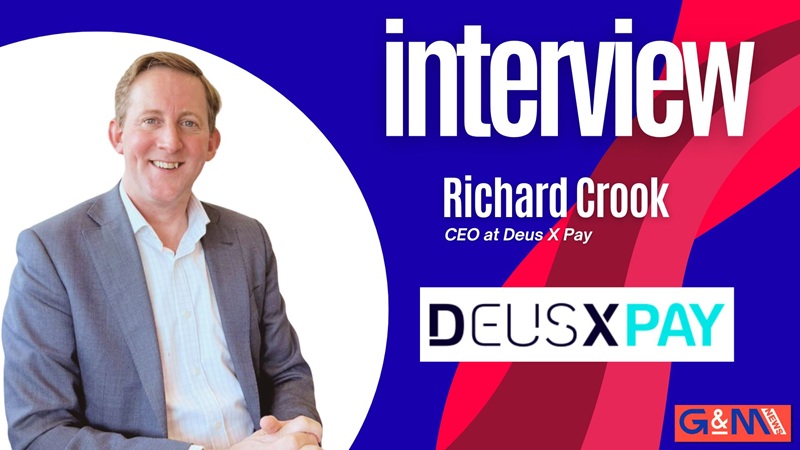
By Roman Frymer, editor at G&M News, with the collaboration of Tatiana Martins, journalist at G&M News.
Can you tell us about your professional trajectory and the industries you’ve worked in?
I started my career at UBS in 2000, within investment banking. After the financial crash, I moved to RBS, where I was involved in restructuring and clean-up efforts. Around 2010, I discovered Bitcoin, which led me to work on emerging technologies, including AI, quantum computing, and blockchain. In 2018, my team and I left RBS to build our own company, where we developed a tokenization engine, perhaps a bit ahead of its time. That technology eventually became part of BCB Group, one of Europe’s largest crypto payment firms. During that period, we navigated major industry challenges such as FTX, Silvergate, and Signature Bank. Later, when I joined Deus X Pay, I realized that stablecoins were becoming a faster, cheaper and safer alternative for cross-border payments. Today, we are based in Dubai (UAE) and focused on enabling real businesses and individuals to use stablecoins to avoid the inefficiencies of traditional correspondent banking systems.
What motivated you to take a deeper look at the gaming industry?
The gaming industry faces challenges very similar to those in traditional banking. Many casinos and gaming operators struggle to even open a bank account, which makes it extremely difficult to run a business. At Deus X Pay, we address this by providing same-named accounts in USD, EUR, and GBP, allowing operators to manage their financial actions more efficiently. This naturally positioned us in a place to support the gaming sector, where access to reliable financial infrastructure is still a major hurdle.
Why do you see Latin America as a key region for the growth of stablecoins?
Latin America is one of the fastest-growing regions for cryptocurrency adoption. What we are seeing, especially in gaming, is that players increasingly want to deposit stablecoins or crypto directly into casinos. Operators are using Deus X Pay to accept these payments, which enables faster, easier, and more secure deposits. This trend is already visible in other markets, and in Latin America, it is gaining strong traction. By offering crypto payment options, casinos are attracting a new segment of players who are already active in the crypto ecosystem.
How is the regulatory landscape evolving across Latin America?
Each country in Latin America is progressing at its own pace, but overall, the direction is very positive. In the gaming sector, we are seeing regulators increasingly engaging with the industry to create frameworks that allow operators to function locally, instead of pushing them offshore. On the payments side, Deus X Pay is a regulated company in both Canada and Dubai, which allows us to operate with strong banking support. This enables us to provide services to operators across Latin America, including access to USD transactions and stablecoin infrastructure.
In which way can operators benefit from offering stablecoins to players in the region?
Operators that accept stablecoins are expanding their reach to a broader audience. They are not only attracting new types of players but also increasing overall inflows into their platforms. In practical terms, this means higher engagement, more deposits, and access to a demographic that prefers digital assets over traditional payment methods.
What about the need to educate different generations about stablecoins?
We are seeing the rise of a new generation for whom the casino is literally in their pockets. It’s no longer a desktop experience or a physical venue; it’s mobile, instant, and always available. This generation is already comfortable with crypto, holding their assets on their phones and expecting seamless, instant transactions. While education is still important for older generations, the shift is being driven by younger users who demand speed, convenience, and digital-first solutions.
What are your expansion plans for Latin America?
We are very proud of the team we have built in Buenos Aires, and Argentina is a key market for us. As we continue to grow, we plan to expand our presence across Latin America, recognizing that each country has its own unique dynamics. Our strategy is to build local teams in different markets, ensuring that we can support operators with tailored solutions and on-the-ground expertise throughout the region.