









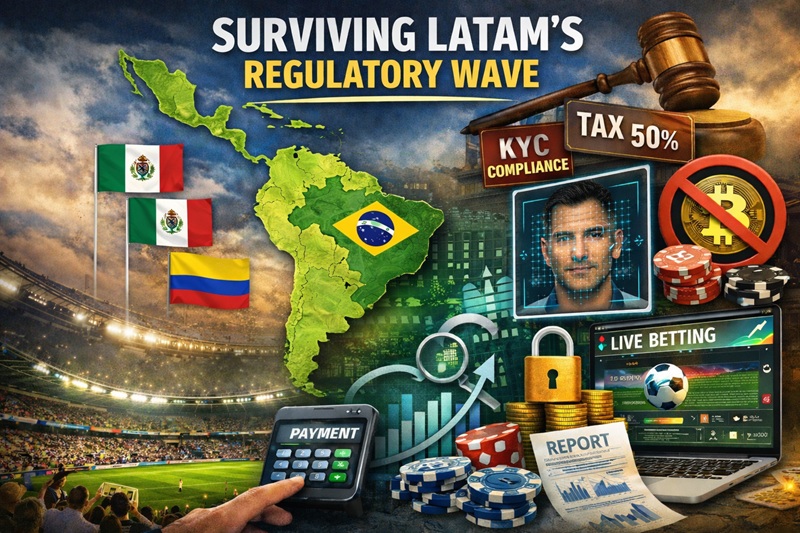
The year 2026 marks a turning point in the history of online gaming in Latin America. What for years was a fragmented ecosystem operating in a gray area has given way to a new order: strict regulation, real-time monitoring, and the end of the acquisition-first business model.
Brazil has definitively closed the door to the gray market. Since January 1st, 2026, the Secretariat of Prizes and Betting (SPA) has moved from issuing recommendations to applying sanctions. Mexico has raised taxes on online betting from 30% to 50%. Colombia now faces a 19% value-added tax on deposits, while Peru and Chile are advancing toward comprehensive regulatory frameworks.
In this context, the question every executive is asking is simple: which operators will survive?
The answer lies in five fundamental capabilities.
1. Mastering hyperlocation
The first distinguishing feature of survivors is abandoning the one-size-fits-all model. Latin America is not a homogeneous market. Operators must understand local behavior. Latin American bettors are among the most football-centric in the world, and the defining trend for 2026 is the massive shift toward player-centric fandom. Younger audiences increasingly follow individual stars, driving a surge in player-specific betting markets.
A streamlined user interface is essential. With the massive volume of matches in leagues like Brazil’s Serie A and Serie B, a powerful search function that takes bettors to their favorite players’ markets in two taps can be the difference between success and failure. Quality local data from providers capable of handling the passionate Latin American fanbase is no longer optional; it’s a baseline requirement.
2. Treating infrastructure as a strategic advantage
For much of the past decade, iGaming growth in Latin America was driven by acquisition-first strategies: strong bonuses, rapid market entry, and substantial media spending. That model has reached its limits.
Payments, identity verification, customer experience, data intelligence, and risk management are now the real drivers of sustainable growth. Latin America is not a single payments ecosystem: approval rates, preferred methods, fraud exposure, and banking expectations vary significantly by country. Operators relying on generic setups face friction, lower conversion, and silent player loss.
KYC processes designed for mature Western markets fail in Latin America when not adapted to local documentation standards and user realities. Customer experience has evolved from a support function to a structural differentiator: players expect rapid resolutions, localized communication, and consistency across all channels.
The operator that survives treats infrastructure as a strategic investment, not a cost center.
3. Achieving real-time technical compliance
Brazil is the preview of what’s coming across the region. The cornerstone of the 2026 compliance framework is mandatory biometric verification; specifically, facial recognition with active or passive liveness detection. Static selfies no longer satisfy the SPA’s Presentation Attack Detection (PAD) standards, and this technology is now the primary defense against generative AI deepfakes and injection attacks that have been accelerating since late 2025.
Real-time CPF validation against the Receita Federal database is equally non-negotiable. Integration with SIGAP -the Ministry of Finance’s centralized monitoring system- requires operators to consult the National Registry of Prohibited Persons before accepting any bet or deposit. Failing to do so carries fines of up to 20% of revenue.
Compliance is no longer an administrative department. It is the technical core of the business.
4. Navigating the tension between cryptocurrency demand and regulatory prohibition
Brazil has formalized the ban on cryptocurrency payments in its licensed market. The immediate impact has been a migration of player liquidity toward crypto casinos operating under offshore licenses, with minimal KYC and fast withdrawals.
The operators that survive are those who understand they cannot ignore the demand for privacy and speed that cryptocurrencies fulfill, but who also cannot operate outside the regulatory framework. The answer is not to compete in the offshore arena, but to offer an experience so seamless, transparent, and secure that players do not perceive the opportunity cost of remaining in the regulated market. The rise of provably fair technology -which allows players to verify game outcomes cryptographically- points toward where this equilibrium will eventually be reached.
5. Building trust in an environment of increasing public scrutiny
In Argentina, the debate over banning gambling advertising is gaining momentum. In Brazil, Bill 2234/22 -which would allow resort casinos and bingo regulation- sits at the center of political debate alongside proposals to restrict gambling advertisements in state contracts. In Mexico, social and political pressure over addiction and unlicensed operations is intensifying.
The operator that survives is not the one that fights these trends, but the one that anticipates them. Social legitimacy is as important as regulatory licensing. Responsible gaming policies that go beyond the minimum required by law are no longer optional extras; they are part of the license to operate in the public eye.
6. Turning data into real-time decisions
Data remains one of the most underutilized assets in the region. Many operators collect large volumes of information but struggle to translate it into actionable, timely decisions. Without advanced analytics and meaningful segmentation, marketing spend becomes inefficient, promotions lose precision, and retention strategies rely on assumptions.
The Brazilian SPA’s 2026–2027 regulatory agenda prioritizes improving monitoring procedures by Q4 2026, meaning reporting standards will tighten further. The operators who will stand out are those whose data architecture allows them to precisely segment players, detect anomalies in real time, optimize acquisition spending, predict churn risk, and report seamlessly to regulators, turning compliance from a burden into a competitive asset.
The cost of not adapting
Operators that rely on aggressive acquisition without operational depth will face increasingly tight margins. In Brazil, taxes on GGR are proposed to reach 18% by 2028. In Mexico, the 50% betting tax is already a reality. In Colombia, the 19% VAT on deposits is being felt.
Operators who neglect compliance technology face license revocation and exclusion from the region’s most important markets. Those who fail to adapt their products to local preferences will lose relevance to competitors who have. Those who fail to build trust with regulators and society will face an increasingly hostile operating environment.
Latin America in 2026 is no longer the new El Dorado of online gaming. It is a mature, demanding market where licenses are a minimum requirement, not a privilege. In this new order, speed is no longer the advantage. Depth is.
The operators who survive will not be the largest or those who spend the most on advertising. They will be the best prepared; those who understood, before everyone else, that the best strategy to conquer a regulated market is to stop thinking about conquering and start thinking about building.