









By Tatiana Martins, journalist at G&M News.
For decades, gambling was effectively absent from the legal and economic vocabulary of the United Arab Emirates. Rooted in cultural and religious principles, the country maintained a clear prohibition stance. That landscape began to shift in 2023 with the creation of a Federal Regulator dedicated to commercial gaming, a move that signaled strategy rather than liberalization.
The establishment of the General Commercial Gaming Regulatory Authority (GCGRA) marked the first formal step toward a regulated national framework. Instead of opening the floodgates, the UAE chose a tightly controlled model, placing federal oversight at the center of every potential operation.
A federal authority with a strategic mandate
The GCGRA was created to develop and oversee a commercial gaming sector under strict regulatory supervision. Its structure reflects the UAE’s governance style: centralized, compliance-driven and aligned with long-term economic planning.
The appointment of experienced international executives, including former regulators from established markets, reinforced the message that the country is prioritizing credibility and global standards from the outset. The regulator has indicated that any licensing process will be selective, highly scrutinized, and aligned with responsible gaming principles.
This is not a race to maximize operator numbers. It is an attempt to integrate gaming into a broader diversification strategy while maintaining social equilibrium.
Ras Al Khaimah and the first integrated resort
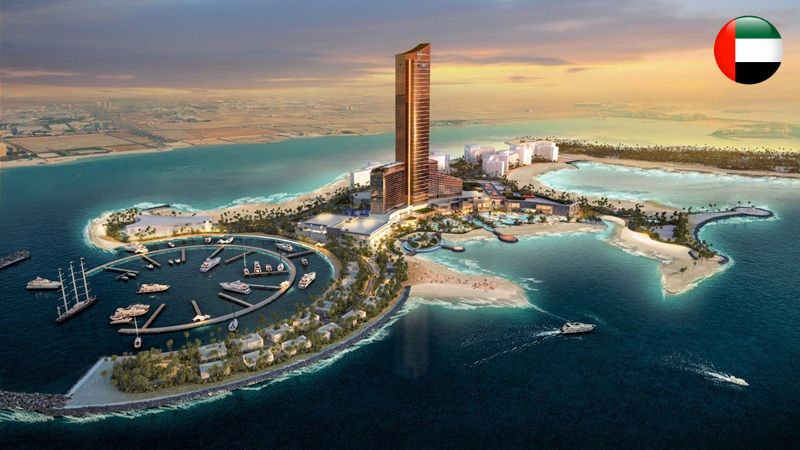
The most visible sign of change emerged in the emirate of Ras Al Khaimah. In 2022, the emirate announced a large-scale integrated resort project developed by Wynn Resorts. In 2023, the company confirmed that the property would include a licensed gaming component, subject to federal approval.
The project, now known as Wynn Al Marjan Island, is expected to open later this decade. It represents the UAE’s first publicly acknowledged move toward land-based casino gaming.
Unlike mass-market casino rollouts seen elsewhere, the UAE approach appears to be destination focused. Integrated resorts are positioned as tourism infrastructure, combining hospitality, entertainment, and convention capacity. Gaming is framed as one component within a broader luxury ecosystem.
Economic diversification as the driving force
The UAE’s pivot must be understood within its wider economic strategy. Through initiatives such as the UAE Centennial 2071 vision and emirate-level diversification plans, the country has consistently aimed to reduce reliance on hydrocarbons.
Tourism, aviation, and real estate have already become pillars of the national economy. Regulated gaming, if implemented on a limited scale, could complement these sectors by attracting high-spending international visitors and extending average stays.
Dubai and Abu Dhabi have not formally announced casino projects, yet both emirates continue expanding hospitality and entertainment infrastructure. Market observers view this as optionality, the ability to scale within a federal framework once the initial model proves stable.
Cultural balance and regulatory credibility
The UAE’s transformation is calibrated. Public messaging avoids aggressive promotion. Discussions focus on regulation, compliance and economic value rather than entertainment appeal. This reflects the country’s broader balancing act: maintaining cultural integrity while positioning itself as a global business hub. Any expansion of gaming will likely include strict access controls, robust AML frameworks, and high entry thresholds for operators.
For international stakeholders, the UAE offers a rare case study. Few jurisdictions move from prohibition to regulation with such deliberate pacing and centralized oversight. The emerging model suggests that controlled entry can serve as a strategic tool rather than a disruptive force.
The UAE is not building a volume-driven gaming market. It is designing a premium, tightly regulated segment aligned with national priorities. Whether this ultra-restrictive framework becomes a regional template remains to be seen. What is clear is that the country is approaching gaming as a calculated policy decision, not a cultural shift.